

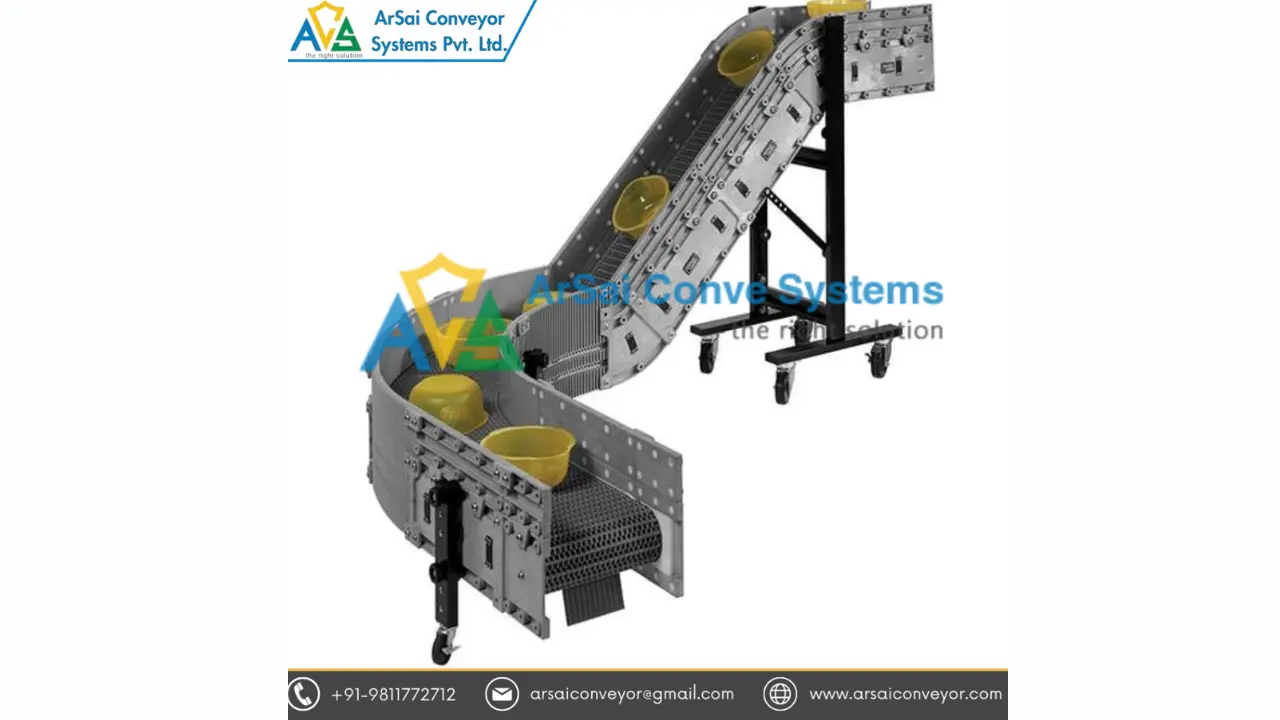
In modern material handling and automation systems, flexibility and efficiency are key factors for smooth operations. One such solution that has gained immense popularity across industries is the modular conveyor. Known for its durability, adaptability, and easy maintenance, a modular conveyor system is widely used in applications where hygiene, precision, and continuous operation are required.
In this blog by ArSai Conveyor Systems Pvt. Ltd. explain what is a modular conveyor, its uses, advantages, limitations, and why modular belt conveyors are an ideal choice for many industrial environments.
What is Modular Conveyor?
A modular conveyor is a type of conveyor system that uses interlocking plastic modules to form a continuous belt. Unlike traditional conveyor belts made from a single piece of material, a modular belt conveyor is constructed from individual sections (modules) connected by hinge rods.
This modular design allows the conveyor belt to be easily repaired, reconfigured, or expanded without replacing the entire belt. Modular-conveyors are especially popular in industries that require frequent cleaning, product changes, or layout modifications.
What Are Modular Conveyors Used For?
Modular-conveyors are used in a wide range of industries due to their versatility and reliable performance. These conveyors are designed to handle products of different shapes, sizes, and weights while maintaining smooth and controlled movement.
They are commonly used in applications where hygiene, accuracy, and durability are essential. Industries such as food processing, pharmaceuticals, packaging, logistics, and manufacturing rely heavily on modular belt conveyors for efficient material handling.
Modular Conveyors Are Also Used to Transport:
- Packaged and Unpackaged Products- A modular belt conveyor can safely transport cartons, bottles, pouches, and containers without damaging the product.
- Food and Beverage Items- Because modular belts are easy to clean and resistant to moisture, they are ideal for food processing and packaging lines.
- Pharmaceutical and Medical Products- Modular-conveyors support hygienic and contamination-free movement of sensitive products.
- Heavy or Irregular Loads- The strong interlocking structure of modular belt conveyors allows them to carry heavier and uneven products with stability.
- Inclined and Declined Movement- Modular-conveyors can be designed with cleats or friction surfaces to move products on inclined or declined paths.
What Are the Advantages of Using Modular Conveyors?
The growing demand for modular-conveyors is driven by several operational and economic advantages that make them superior to conventional conveyor belts in many applications.
One of the biggest advantages of a modular belt conveyor is ease of maintenance. If a section of the belt is damaged, only the affected module needs to be replaced, reducing downtime and maintenance costs.
Modular-conveyors also offer excellent flexibility. Their design allows easy modification of conveyor length, width, or direction, making them suitable for changing production layouts.
Hygiene is another major benefit. Modular belt conveyors are easy to clean and resistant to chemicals, moisture, and corrosion, making them ideal for food and pharmaceutical industries.
Additionally, modular-conveyors provide strong traction and stable product movement. They can operate smoothly at different speeds and are suitable for straight, curved, inclined, and spiral configurations.
What Are the Disadvantages of Using Modular Plastic Conveyor Belts?
While modular conveyors offer many advantages, it is important to understand their limitations to make an informed decision.
One limitation of modular plastic conveyor belts is their higher initial cost compared to traditional belt conveyors. However, this cost is often justified by lower maintenance expenses and longer service life.
Modular belts may also generate more noise than fabric or rubber belts, especially at higher speeds or in curved sections. Proper design and installation can help minimize this issue.
Another consideration is weight. Modular belt conveyors are generally heavier than standard belts, which may require stronger support structures and motors.
Despite these limitations, for most industrial applications, the long-term benefits of modular conveyors outweigh the disadvantages.
Why Choose Modular Belt Conveyors for Industrial Applications?
Choosing a modular belt conveyor is ideal for industries that demand durability, flexibility, and hygienic operation. These conveyors are particularly beneficial in automated production lines where downtime and inefficiency can lead to significant losses.
At ArSai Conveyor Systems Pvt. Ltd., modular conveyors are designed with precision engineering to meet specific application requirements. Our solutions ensure smooth product flow, easy maintenance, and long-term operational reliability.
Applications of Modular Conveyors
- Modular conveyors are widely used in:
- Food and beverage processing plants
- Pharmaceutical manufacturing units
- Packaging and labeling lines
- Warehouses and distribution centers
- Automotive and electronics industries
Their ability to handle diverse products and layouts makes modular belt conveyors a preferred choice for modern industrial facilities.
Conclusion
So, what is a modular conveyor? It is a versatile, durable, and efficient material handling solution designed to meet the evolving needs of modern industries. With their interlocking design, easy maintenance, and adaptability, modular conveyors offer significant advantages over traditional conveyor systems.
Although modular plastic conveyor belts have a few limitations, their long-term performance, hygiene benefits, and flexibility make them a smart investment. ArSai Conveyor Systems Pvt. Ltd. is committed to delivering high-quality modular belt conveyor solutions that enhance productivity and efficiency across industries.
To read the basic definition of conveyor systems, click here: What is a Conveyor System? Definition and More

Pingback: What is Flat Belt Conveyor? Design, Parts & Price Guide