

In manufacturing, warehousing, packaging, logistics, and many other industries, moving products from one point to another is a regular part of daily operations. When this movement is handled manually, it can take considerable time and effort, especially when products are heavy, delicate, or required in large quantities. This is where conveyor technology becomes valuable.
But what is a conveyor system, and why is it so widely used in modern industries? Simply put, a conveyor system is a mechanical material-handling arrangement designed to transport products, components, raw materials, packages, or other items along a defined path. Depending on the application, it can be a simple belt conveyor or a highly automated conveying line integrated with production machinery.
ArSai Conveyor Systems Pvt. Ltd. provides conveyor solutions designed for different industrial material-handling requirements, helping businesses improve product movement, workflow, and operational efficiency.
What Is a Conveyor System?
A conveyor system is equipment used to move materials continuously or in controlled batches from one location to another. The conveying surface can be a belt, roller, chain, slat, modular belt, or another suitable mechanism.
Unlike manual material handling, conveyors provide a predetermined movement path. This makes them particularly useful when products need to travel repeatedly between production stages.
For example, a manufacturing facility may use a conveyor to move components from assembly to inspection and then from inspection to packaging. Similarly, a warehouse may use conveyors to transport cartons from storage areas to sorting or dispatch sections.
Modern conveyor systems can be designed in straight, curved, inclined, vertical, or overhead configurations according to the available space and process requirements.
How Do Conveyors Work?
Understanding how conveyors work starts with their basic operating principle. Most powered conveyors use an electric motor connected to a gearbox or drive mechanism. The motor provides rotational movement to the conveyor’s driving component.
In a belt conveyor, for example, the drive pulley rotates and moves the continuous belt around the conveyor frame. Products placed on the belt are carried along with it.
Roller conveyors work differently. They use a series of rollers that rotate to move products across the conveying surface. Some roller conveyors use gravity, while powered roller conveyors use motors to control movement.
Chain conveyors use chains to move products, while modular belt conveyors use interconnected belt modules driven by sprockets.
Although the mechanisms differ, the main purpose remains the same: controlled and efficient movement of materials from one point to another.
Main Components of a Conveyor System
The exact components vary according to conveyor type, but a typical system may include several important parts.
Conveyor Frame
The frame provides the main structural support for the conveyor. It holds components such as rollers, pulleys, belts, bearings, and drive assemblies.
Frames may be manufactured from materials such as mild steel, stainless steel, or other suitable materials depending on the application.
Conveyor Belt or Conveying Surface
The conveying surface is the part that directly carries the product. Depending on the system, it may be a rubber belt, PVC belt, PU belt, modular plastic belt, slats, rollers, or chains. The material and design should be selected according to product characteristics and operating conditions.
Drive Motor
Powered conveyors require a motor to generate movement. Motor selection depends on factors such as conveyor length, load, speed, incline, and operating conditions.
Gearbox
A gearbox can reduce motor speed and provide the torque required to drive the conveyor efficiently.
Rollers and Pulleys
Belt conveyors generally use pulleys to guide and drive the belt. Support rollers may be used underneath the belt to carry the load and maintain proper belt movement.
Bearings
Bearings support rotating components and allow them to operate smoothly while reducing friction.
Control System
Modern conveyors may use control panels, switches, sensors, variable-frequency drives, programmable controllers, and other devices to control movement.
Safety Components
Depending on the application, conveyor systems can include emergency-stop switches, guards, protective covers, warning devices, and other safety arrangements.
Types of Conveying Systems
Different industries require different types of conveying systems. The appropriate design depends on product characteristics, production volume, distance, speed, and facility layout.
Belt Conveyor
Belt conveyors are among the most commonly used conveyors. They are suitable for boxes, packages, components, bags, and many general material-handling applications.
Roller Conveyor
Roller conveyors use rollers to transport products. They are commonly used for cartons, boxes, containers, pallets, and products with stable bases.
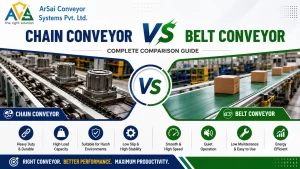
Chain Conveyor
Chain conveyors are suitable for heavier products and industrial applications where a robust conveying mechanism is required.
Slat Conveyor
Slat conveyors use interconnected slats to provide a stable conveying surface. They are commonly used for bottles, containers, packaging, and assembly applications.
Modular Belt Conveyor
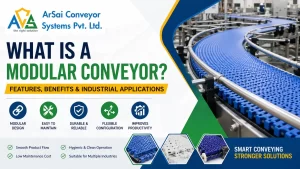
Modular conveyors use interlocking belt modules. This design can simplify belt maintenance because individual sections can be replaced when required.
Overhead Conveyor
Overhead conveyors transport products above the floor. They can help save floor space and are frequently used in automotive, coating, painting, garment, and assembly applications.
Screw Conveyor
Screw conveyors use a rotating screw to move bulk materials such as powders, granules, grains, and other materials through a controlled path.
Where Are Conveyor Systems Used?
The wide range of conveyor designs makes them suitable for numerous industries.
Manufacturing
Factories use conveyors to move raw materials, components, work-in-progress products, and finished goods between different production stages.
Automotive
Automotive plants use specialized conveyors for assembly, component handling, inspection, painting, and other manufacturing processes.
Food Processing
Food and beverage facilities use suitable conveyor designs for transporting ingredients, containers, packaged products, bottles, and other materials.
Packaging
Conveyors are an important part of filling, sealing, labeling, sorting, inspection, and packing lines.
Warehousing and Logistics
Distribution centers use conveyors to transport cartons, parcels, packages, and containers between storage, sorting, and dispatch areas.
Pharmaceutical Industry
Pharmaceutical manufacturers and packaging facilities can use controlled conveying equipment to move bottles, cartons, containers, and finished packages.
Benefits of Using Conveyors
The growing use of conveyors across industries is largely due to their ability to improve material movement and workflow.
Reduces Manual Handling
Conveyors can reduce the need for employees to repeatedly carry materials between workstations.
Improves Productivity
Continuous and controlled product movement can help production lines maintain a consistent workflow.
Saves Time
Automated or mechanically assisted movement can reduce the time required to transfer products between different areas.
Better Material Flow
A defined conveying route helps create a more organized movement of materials within a facility.
Flexible Layouts
Conveyor systems can be designed for different floor plans, including straight, curved, inclined, and overhead layouts.
Supports Automation
Modern systems can be integrated with sensors, robotics, scanners, control systems, and other automated equipment.
Manual Handling vs Conveyor-Based Material Movement
Manual handling can be practical for small-scale operations or products that require occasional movement. However, as production volume increases, depending entirely on manual transportation may become inefficient.
Conveyors provide a more consistent approach to repetitive material movement. They can operate at controlled speeds and follow predetermined routes, allowing workers to focus on production, inspection, packaging, or other tasks.
The objective is not necessarily to eliminate manual work completely but to use equipment where repetitive movement can be handled more efficiently.
How to Select the Right Conveyor System?
Selecting the right system requires an understanding of the application.
First, consider the product. Its weight, dimensions, shape, surface, and fragility influence conveyor selection.
Next, determine the required capacity and speed. A system designed for low-volume production may not be suitable for a high-output manufacturing line.
The available space and layout should also be evaluated. Depending on the facility, a straight, inclined, curved, vertical, or overhead conveyor may be appropriate.
Operating conditions are equally important. Temperature, moisture, dust, chemicals, cleaning requirements, and hygiene standards can influence the choice of conveyor material and components.
Finally, consider future production requirements. A system designed with flexibility and expansion in mind can be easier to modify as the business grows.
Automation in Modern Conveyor Systems
Today’s conveyor technology goes beyond simply moving products. Advanced conveyor systems can be integrated with sensors and control systems to automate product movement.
Sensors can detect products, monitor positions, control accumulation, and trigger transfers. Programmable control systems can coordinate conveyors with machines and other production equipment.
This makes conveyors an important part of automated manufacturing and warehouse operations.
For high-volume facilities, automated conveying can help improve consistency and reduce unnecessary manual intervention.
Why Choose ArSai Conveyor Systems Pvt. Ltd.?
Every industrial facility has different material-handling requirements. A standard conveyor may not always provide the right combination of capacity, speed, dimensions, layout, and automation.
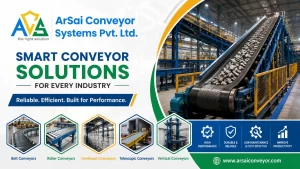
ArSai Conveyor Systems Pvt. Ltd. provides conveyor solutions designed around specific industrial applications. The right combination of conveyor type, frame construction, drive system, belt or conveying surface, controls, and accessories can be selected according to the customer’s requirements.
A professionally designed system can help businesses establish smoother material flow while making better use of available production space.
Conclusion
So, what is a conveyor system? It is a mechanical material-handling solution designed to move products, materials, or components efficiently along a defined route. From simple belt and roller conveyors to modular, chain, slat, overhead, and automated systems, conveyors are available in many configurations.
Understanding how conveyors work, their major components, and their applications makes it easier to select the right equipment for a particular operation.
For manufacturing, packaging, logistics, food processing, automotive, pharmaceutical, and other industries, the right conveying solution can reduce repetitive manual handling, improve workflow, save time, and support consistent production.
With properly engineered conveying systems from an experienced manufacturer such as ArSai Conveyor Systems Pvt. Ltd., businesses can develop practical and scalable material-handling solutions suited to their present requirements and future growth.