
In modern manufacturing, moving materials efficiently from one stage to another is just as important as the production process itself. Raw materials, components, cartons, finished products, and packaged goods often need to travel continuously across different workstations. Relying completely on manual handling can increase labor requirements, slow down production, and make material flow less consistent. This is why industrial conveyor systems have become an essential part of modern factories and material-handling operations.
From simple belt conveyors to advanced automated conveying lines, conveyor technology can be customized for different products, industries, layouts, and production capacities. A properly designed conveyor can improve workflow while making the movement of materials more organized and predictable.
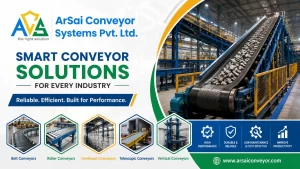
ArSai Conveyor Systems Pvt. Ltd. provides customized conveyor solutions for industrial applications, helping businesses select suitable equipment according to their products, production requirements, available space, and operating environment.
What Are Industrial Conveyor Systems?
Industrial conveyor systems are mechanical material-handling systems designed to transport products, components, raw materials, or packages from one location to another within a facility. Depending on the application, conveyors may use belts, rollers, chains, slats, modular belts, or other conveying mechanisms.
These systems can be installed horizontally, vertically, at an incline, or in customized layouts. They can connect production machines, assembly stations, inspection areas, packaging lines, warehouses, and dispatch sections.
The main purpose of an industrial conveyor is to create a consistent flow of material while reducing unnecessary manual movement.
Modern systems can also include sensors, motors, variable-speed drives, control panels, and automation technologies to provide greater control over material movement.
Also Read: What Is a Conveyor System? Definition, Working & Components
How Does an Industrial Conveyor Work?
The working principle depends on the type of conveyor being used. In a belt-based system, an electric motor and gearbox drive a pulley, which moves the continuous belt around the conveyor frame.
Products placed on the belt travel along the predetermined route and are discharged at the required location.
An industrial conveyor may include several components, such as:
- Conveyor belt or conveying surface
- Drive motor and gearbox
- Drive and tail pulleys
- Rollers or support surfaces
- Conveyor frame
- Bearings
- Belt tensioning arrangement
- Side guides
- Control system
- Safety devices
The exact configuration depends on product characteristics, conveyor length, load capacity, speed, and layout.
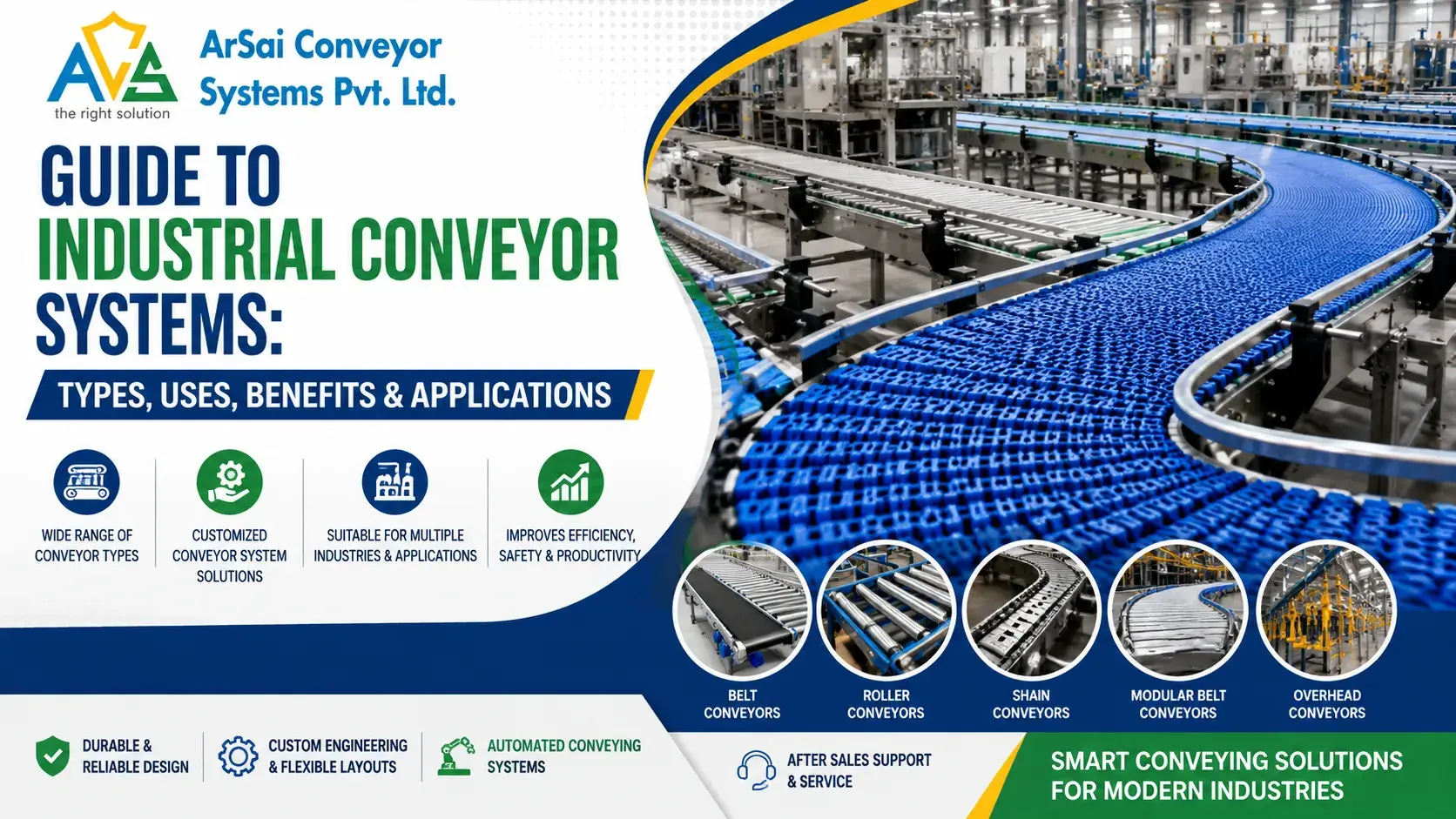
Types of Industrial Conveyor Systems
Different industries require different conveying technologies. Choosing the correct type is important for achieving reliable performance.
Industrial Belt Conveyor
An industrial conveyor belt system uses a continuous belt to transport products or materials. It is one of the most versatile conveyor solutions and can be used for cartons, bags, components, packages, and many other products.
Depending on the design, belt conveyors can be configured for horizontal, inclined, or customized conveying applications.
Belt material can also vary according to the operating environment and product requirements.
Industrial Roller Conveyor
An industrial roller conveyer uses a series of rollers to move products along a defined path. It is particularly useful for cartons, boxes, pallets, containers, and products with a stable bottom surface.
Roller conveyors can be gravity-operated or powered. Powered versions provide controlled movement and can be integrated with automated production and warehouse systems.
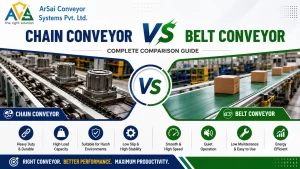
Chain Conveyor
Chain conveyors use chains as the primary conveying mechanism and are suitable for heavy-duty applications. They can handle pallets, containers, industrial components, and products that may be unsuitable for conventional belts.
Their robust construction makes them useful in manufacturing and assembly environments.
Slat Conveyor
Slat conveyors use interconnected slats mounted on a chain mechanism. They provide a stable conveying surface and can be useful for bottles, containers, components, and products requiring firm support during movement.
Modular Belt Conveyor
Modular belt conveyors use individual interlocking modules to create the conveying surface. One advantage of this design is that individual belt sections can be replaced when necessary.
They can be useful in food processing, packaging, pharmaceutical, and other applications where cleaning and maintenance are important.
Overhead Conveyor
Overhead conveyors transport products above the working area. This allows businesses to utilize vertical space while keeping the floor relatively clear.
They are frequently used in automobile manufacturing, paint shops, coating lines, assembly operations, and other industrial applications.
Applications of Industrial Conveyor Systems
The versatility of conveyors makes them suitable for numerous industries.
Manufacturing and Engineering
Factories use conveyors to transport raw materials, components, work-in-progress products, and finished goods between different production stages.
Automotive Industry
Automotive manufacturing plants use conveyor systems for component handling, assembly, inspection, painting, and movement of vehicle parts.
Packaging Industry
Conveyors help move products through filling, sealing, labeling, inspection, sorting, and packaging operations.
Food and Beverage
Specialized conveyor systems can transport ingredients, containers, packaged food, bottles, cans, and other products through processing and packaging stages.
Warehousing and Logistics
Conveyors can improve the movement of cartons, parcels, containers, and packages inside warehouses and distribution centers.
Pharmaceutical Industry
Controlled conveying systems can be used for moving containers, cartons, bottles, and packaged products through manufacturing and packaging areas.
Benefits of Industrial Conveyor Systems
Improved Material Flow
Conveyors create a defined path for product movement. This helps maintain a continuous flow between different workstations.
Reduced Manual Handling
Automating repetitive material movement can reduce the need for workers to carry products manually from one location to another.
Increased Productivity
A properly designed conveyor can move products consistently at a predetermined speed, helping production lines maintain their required output.
Better Space Utilization
Overhead, inclined, vertical, and customized conveyors can help businesses make better use of limited production-floor space.
Consistent Movement
Conveyor systems provide controlled and predictable product movement, which is especially useful when several production processes need to work together.
Easier Integration
Modern conveyors can be integrated with sensors, machines, robotics, scanners, and control systems to create more coordinated production operations.
What Are Conveyor System Solutions?
Conveyor system solutions are complete material-handling arrangements designed around a specific industrial requirement rather than a standard conveyor alone.
For example, a manufacturing plant may require a combination of belt conveyors, roller conveyors, transfers, sensors, controls, and safety equipment to connect different production stages.
A professional conveyor solution considers product dimensions, weight, production capacity, conveying distance, speed, floor layout, environmental conditions, and future expansion requirements.
This approach helps ensure that the conveyor is not only capable of moving products but also fits effectively into the complete production workflow.
Material Conveying Systems for Modern Factories
Material conveying systems can significantly improve the organization of industrial facilities. Instead of moving materials randomly between workstations, a planned conveying route establishes a structured flow.
This can be particularly valuable in high-volume manufacturing environments where products need to pass through multiple operations.
For example, raw components may travel from storage to assembly, then to inspection, packaging, and finally to dispatch. A properly engineered conveyor network can connect these stages while minimizing unnecessary movement.
The design should always be based on the actual material-handling process rather than simply selecting equipment based on available space or initial cost.
Automated Conveying Systems
The growing use of industrial automation has made automated conveying systems increasingly important.
Automated conveyors can incorporate sensors, programmable controllers, variable-frequency drives, barcode systems, scanners, and other technologies. These components can help control when products start, stop, transfer, accumulate, or move to another processing stage.
For example, a sensor can detect when a product reaches a particular position and communicate with the control system. The conveyor can then stop, start, divert, or transfer the product according to the programmed process.
Automation is particularly useful in large manufacturing plants, warehouses, packaging facilities, and distribution centers where product movement needs to be coordinated with other equipment.
How to Choose the Right Industrial Conveyor?
Selecting an industrial conveyor requires careful evaluation of the application.
- Product characteristics: Consider size, weight, shape, surface, and fragility.
- Required capacity: Determine how many products or how much material must be transported per hour.
- Conveyor speed: Select a suitable operating speed based on production requirements and product stability.
- Layout: Consider available floor space, conveying distance, height differences, curves, and transfer points.
- Operating environment: Temperature, moisture, dust, chemicals, cleaning requirements, and hygiene conditions may influence the conveyor design.
- Future requirements: If production is expected to expand, the conveyor should ideally allow future modifications or extensions.
Why Choose Professional Industrial Conveyor Manufacturers?
Choosing experienced industrial conveyor manufacturers is important because conveyor performance depends on proper engineering as much as on individual components.
A professional manufacturer can evaluate the application and recommend suitable belt type, frame construction, drive arrangement, conveyor dimensions, speed, controls, and accessories.
A customized design can also address unusual product dimensions, limited floor space, special operating conditions, or integration with existing machinery.
ArSai Conveyor Systems Pvt. Ltd. focuses on industrial conveyor solutions designed around individual material-handling requirements. This application-oriented approach can help businesses develop conveying systems that fit their production processes instead of forcing the process to fit a standard conveyor.
Maintenance and Safety
Regular maintenance is essential for reliable conveyor operation. Operators should inspect belts, rollers, bearings, motors, gearboxes, chains, sprockets, pulleys, and supporting structures at suitable intervals.
Unusual noise, vibration, belt misalignment, excessive wear, or inconsistent movement should be investigated promptly.
Safety is equally important. Appropriate guards, emergency-stop arrangements, warning signs, safe access, and other protective measures should be incorporated according to the conveyor design and application.
Proper operator training can also help prevent accidents and unnecessary equipment damage.
Conclusion
Industrial conveyor systems are an important part of modern manufacturing, warehousing, packaging, logistics, and material-handling operations. From an industrial conveyor belt to roller, chain, modular, slat, and overhead systems, different conveyor technologies can be selected according to the product and application.
The right conveyor can reduce manual handling, improve material flow, support consistent production, and make better use of available space. When combined with sensors and control technologies, automated conveying systems can take material handling to an even higher level of efficiency.
For businesses looking for reliable conveyor system solutions, selecting an experienced manufacturer and focusing on application-specific design is essential. ArSai Conveyor Systems Pvt. Ltd. can help industries develop practical material conveying systems based on product requirements, production capacity, plant layout, and future operational needs.