

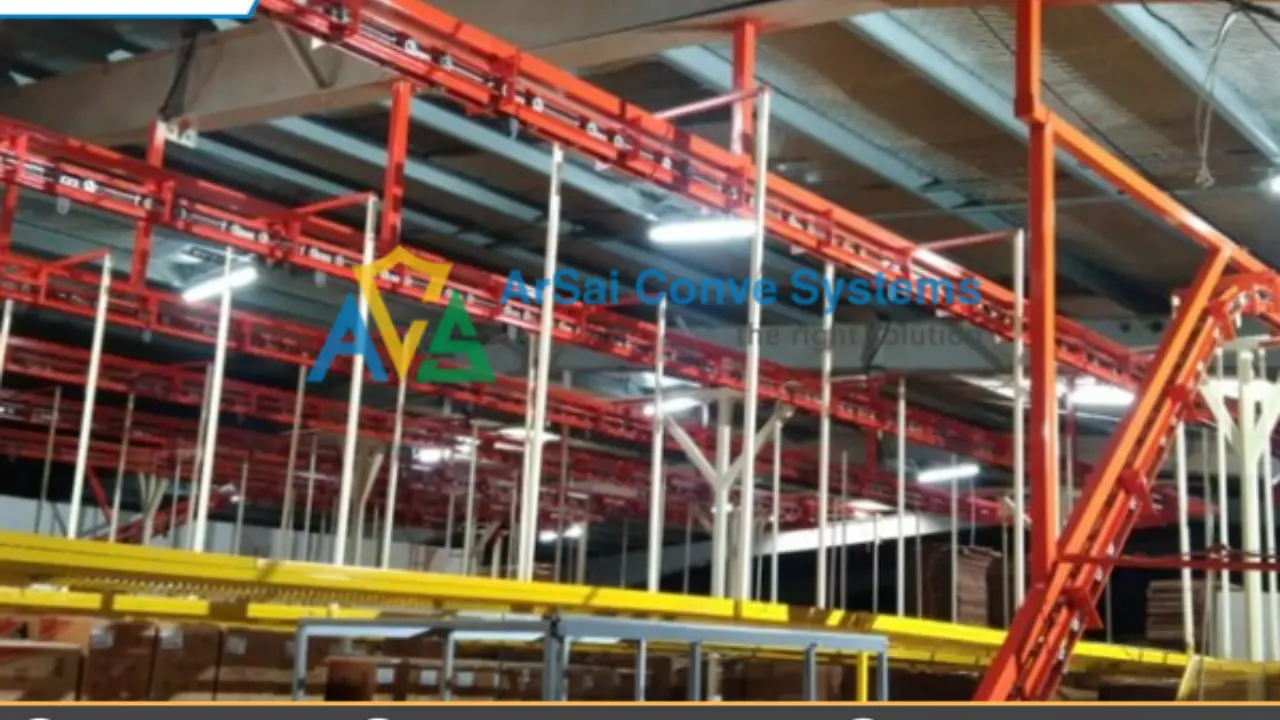
In modern manufacturing and material handling industries, flexibility and process control are essential for achieving high productivity. Traditional conveyor systems often limit movement by operating at a fixed speed and sequence. To overcome these limitations, industries increasingly rely on the power and free conveyor system. This advanced conveyor solution allows independent movement, accumulation, and routing of loads, making it ideal for complex production environments.
ArSai Conveyor Systems Pvt. Ltd. design and manufacture high-performance power and free conveyor systems according to automotive, engineering, painting, and heavy-duty industrial applications. To fully understand how these systems operate efficiently, it is important to know the key power and free conveyor components and their functions.
Why Understanding Power and Free Conveyor Components Is Important?
Each component in a power and free conveyor plays a critical role in ensuring smooth operation, safety, and system efficiency. A well-designed system depends not only on overall layout but also on the quality and integration of individual components. Proper selection of power and free conveyor components improves reliability, reduces downtime, and enhances productivity.
Main Power and Free Conveyor Components
Power Chain
The power chain is the backbone of the power and free conveyor system. It runs continuously along the conveyor track and provides the driving force for the system. Powered by electric motors and gearboxes, the power chain transfers motion to the free trolleys when engaged.
A robust and well-aligned power chain ensures consistent speed and smooth operation across the entire conveyor system.
Free Trolleys
Free trolleys are load-carrying units that move independently from the power chain. These trolleys can engage or disengage from the power chain as required, allowing loads to stop at workstations without stopping the entire system.
In power and free conveyors, free trolleys provide flexibility by enabling accumulation, indexing, and selective movement of products.
Load Trolleys and Hangers
Load trolleys and hangers support and carry the actual product or material. They are designed based on load capacity, product shape, and application requirements. Proper design of these components is critical for safety and stability, especially in heavy-duty power and free conveyor systems.
Conveyor Track System
The track system guides both the power chain and free trolleys along predefined paths. Tracks are engineered to handle straight sections, curves, inclines, and declines. High-quality track design ensures minimal friction, smooth movement, and long service life.
The track layout plays a key role in power and free roller conveyor design, particularly in systems requiring precise routing and positioning.
Switches and Diverters
Switches and diverters are essential power and free conveyor components that allow carriers to change direction. These components enable routing of products to different lines, workstations, or processes without manual handling.
Switches can be mechanically or pneumatically operated and are widely used in complex power and free conveyor systems.
Stops and Accumulation Units
Stops control the movement of free trolleys by engaging or disengaging them from the power chain. Accumulation units allow multiple carriers to queue without contact or damage.
These components are vital in assembly lines, painting systems, and inspection stations where controlled stopping is required.
Drive Units
Drive units consist of motors, gearboxes, and drive sprockets that power the system. Proper sizing of drive units ensures efficient energy use and consistent performance of the power and free conveyor.
Multiple drive units may be used in large power and free conveyor systems to maintain speed and torque across long distances.
Power and Free Roller Conveyor Components
A power and free roller conveyor is a specialized variation where rollers are integrated into the system for smoother load handling. These systems are commonly used for pallets, skids, and heavy assemblies.
Key power and free roller conveyor components include:
- Driven rollers
- Free rollers
- Roller beds
- Transfer units
The success of a power and free roller conveyor design depends on roller spacing, load distribution, and material flow requirements.
Role of Power and Free Roller Conveyor Design
Effective power and free roller conveyor design ensures smooth load transfer, reduced friction, and minimal wear. Design considerations include:
- Load weight and size
- Roller diameter and material
- Speed control requirements
- Accumulation and transfer points
A well-engineered design improves system efficiency and reduces maintenance needs.
Applications of Power and Free Conveyor Systems
Due to their flexibility and control, power and free conveyors are widely used across industries.
- Automotive Industry- Used in body assembly, paint shops, and final assembly lines.
- Heavy Engineering- Ideal for handling large components with controlled movement and accumulation.
- Surface Treatment and Painting Lines- Allows products to stop inside ovens, booths, and curing zones without interrupting flow.
- Manufacturing and Assembly- Supports variable cycle times and multiple workstations.
- Warehousing and Material Handling- Used for sorting, buffering, and automated material flow.
Advantages of Power and Free Conveyor Systems
Understanding the components highlights why power and free conveyor systems are preferred over traditional conveyors.
- Independent carrier control
- Flexible routing and expansion
- Reduced production bottlenecks
- Improved automation compatibility
- Enhanced system reliability
These advantages make power and free conveyors a long-term, scalable solution for modern industries.
Advantages of Power and Free Conveyor Systems
Understanding the components highlights why power and free conveyor systems are preferred over traditional conveyors.
- Independent carrier control
- Flexible routing and expansion
- Reduced production bottlenecks
- Improved automation compatibility
- Enhanced system reliability
These advantages make power and free conveyors a long-term, scalable solution for modern industries.
Why Choose ArSai Conveyor Systems Pvt. Ltd.?
At ArSai Conveyor Systems Pvt. Ltd., we specialize in designing and manufacturing customized power and free conveyor systems built to meet specific industrial requirements.
Our expertise includes:
- Precision-engineered power and free conveyor components
- Advanced power and free roller conveyor design
- High-quality materials and fabrication
- End-to-end project support
We focus on delivering systems that enhance productivity, safety, and operational efficiency.
Conclusion
Understanding power and free conveyor components is essential for selecting and operating an efficient material handling system. Each component—from power chains and free trolleys to switches and roller conveyors—plays a vital role in system performance.
With proper design and integration, power and free conveyor systems offer unmatched flexibility, control, and efficiency. Whether for automotive manufacturing, heavy engineering, or automated assembly lines, power and free conveyors provide a reliable and future-ready solution.
For expertly engineered power and free conveyor systems, ArSai Conveyor Systems Pvt. Ltd. stands as a trusted partner in industrial material handling.
Pingback: What is a Towline Conveyor? | ArSai Conve Systems