

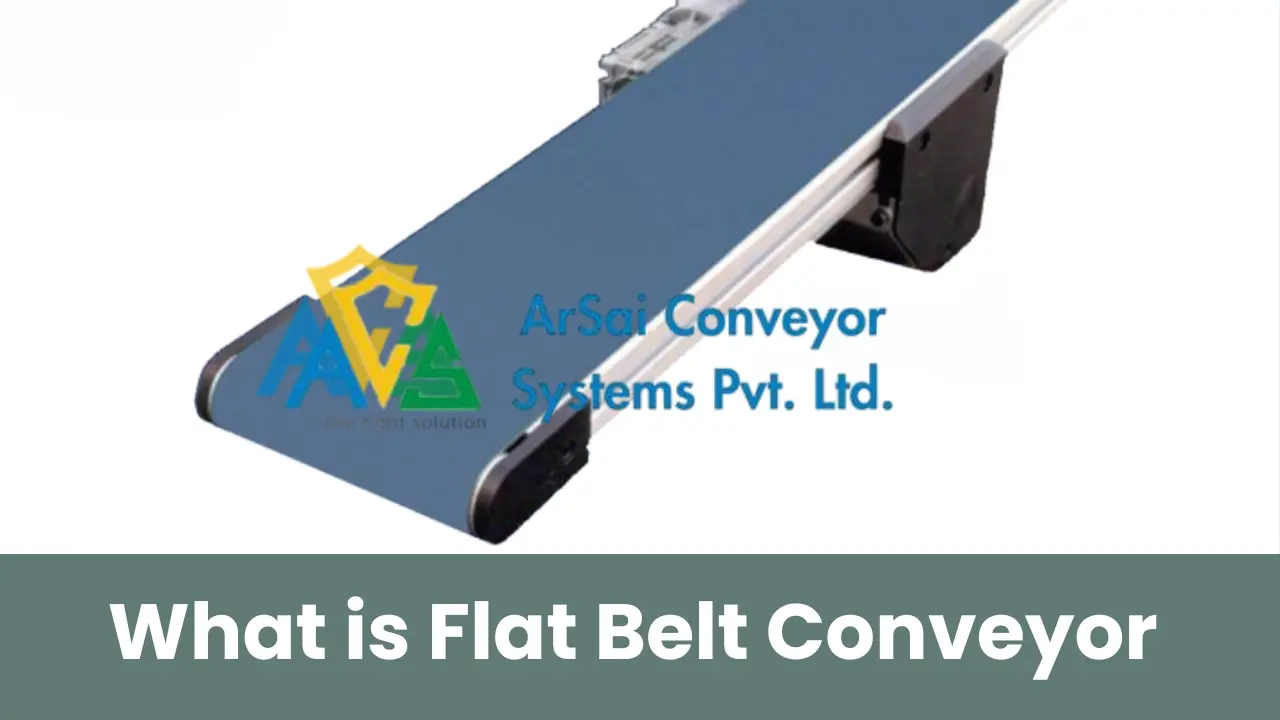
A flat belt conveyor is one of the most widely used material handling systems in modern industries. When people ask what is flat belt conveyor, they are usually referring to a conveyor system that uses a continuous flat belt to move materials smoothly from one point to another. This type of conveyor is known for its simplicity, efficiency, and adaptability across a wide range of applications. Due to its reliable operation and cost-effectiveness, flat belt conveyors are commonly installed in manufacturing units, warehouses, assembly lines, and logistics centers.
ArSai Conveyor Systems Pvt. Ltd. are manufactured flat belt conveyors to deliver consistent performance while meeting specific operational requirements.
How a Flat Belt Conveyor Works?
Understanding how a flat belt conveyor functions makes it easier to appreciate its value in industrial operations. The system operates with the help of an electric motor that drives a pulley. This pulley moves the flat belt forward in a continuous loop. Materials placed on the belt are carried smoothly along the conveyor length until they reach the discharge point.
The steady motion of the belt ensures minimal vibration and noise, which is why flat-belt conveyors are preferred in environments where smooth handling is critical. This working principle remains the same regardless of whether the conveyor is short or long, light-duty or heavy-duty.
Also Read: What is a Modular Conveyor?
Flat Belt Conveyor Design and Engineering
A well-planned Flat-Belt Conveyor design is essential for achieving efficiency, durability, and safety. The design depends on several factors such as the type of material being conveyed, load capacity, belt speed, conveyor length, and operating conditions. Engineers carefully select belt material, pulley size, drive system, and frame structure to match the application.
Proper flat-belt conveyor design ensures uniform load distribution and reduces wear on the belt and other components. A customized design not only improves productivity but also lowers maintenance costs and extends the life of the conveyor system.
Understanding the Flat Belt Conveyor Diagram
A flat-belt conveyor diagram provides a clear visual representation of how the system components are arranged and connected. It typically illustrates the belt path, drive pulley, tail pulley, motor, gearbox, and supporting structure. By studying a flat-belt conveyor diagram, operators and maintenance teams can easily understand the flow of material and identify key components.
Diagrams are especially useful during installation, troubleshooting, and routine inspection, as they help in locating parts and understanding how changes in one component can affect overall conveyor performance.
Flat Belt Conveyor Parts and Their Importance
The efficiency of a conveyor system depends heavily on the quality and condition of its components. The major flat belt conveyor parts include the belt, pulleys, drive unit, frame, and belt support system. Each part plays a vital role in maintaining smooth and reliable operation.
The flat belt acts as the material-carrying surface, while pulleys guide and move the belt. The drive unit supplies the required power, and the frame provides structural stability. When all flat belt conveyor parts work together seamlessly, the system delivers consistent output with minimal downtime.
Applications of Flat-Belt Conveyors
Flat-belt conveyors are widely used across multiple industries due to their versatility. They are commonly installed in manufacturing plants for assembly operations, in warehouses for material transfer, and in packaging lines for product movement. Industries such as food processing, pharmaceuticals, automotive, electronics, and logistics rely heavily on flat-belt conveyors for efficient handling.
Their ability to transport materials of different shapes and sizes makes them suitable for both bulk materials and individual items. This adaptability further explains why businesses prefer flat belt conveyors over more complex conveying systems.
Advantages of Using Flat Belt Conveyors
One of the main reasons industries invest in flat-belt conveyors is their operational efficiency. These conveyors offer smooth material movement, low noise levels, and reduced power consumption. Their simple construction makes them easy to install and maintain, while their flexible design allows customization for specific applications.
Another significant advantage is their ability to operate over long distances without compromising performance. With proper flat belt conveyor design, these systems provide long-term reliability and consistent output, making them a valuable asset for any industrial facility.
Flat Belt Conveyor Price and Cost Factors
The flat belt conveyor price depends on several technical and operational factors. Conveyor dimensions, belt material, load capacity, speed, and frame construction all influence the overall cost. Basic conveyors used for light-duty applications are relatively affordable, while heavy-duty or customized systems cost more due to advanced components and engineering.
At ArSai Conveyor Systems Pvt. Ltd., flat belt conveyor price is determined after carefully evaluating the client’s requirements to ensure they receive the most cost-effective solution without compromising quality or performance.
Maintenance and Performance Optimization
Regular maintenance is essential to ensure smooth operation and long service life. Proper belt alignment, correct tensioning, and periodic inspection of flat belt conveyor parts help prevent unexpected breakdowns. Cleaning the belt surface and checking drive components further enhance system reliability.
A well-maintained flat belt conveyor not only improves productivity but also reduces repair costs and operational interruptions, making maintenance a crucial aspect of conveyor management.
Why Choose ArSai Conveyor Systems Pvt. Ltd.?
ArSai Conveyor Systems Pvt. Ltd. is a trusted name in the design and manufacturing of advanced material handling solutions. Our flat belt conveyors are built using high-quality materials and precision engineering to meet diverse industrial needs. We focus on delivering systems that combine efficient flat belt conveyor design with competitive pricing and dependable performance.
From conceptual planning and detailed flat belt conveyor diagrams to installation and after-sales support, we provide end-to-end conveyor solutions that help businesses achieve operational excellence.
Conclusion
Now that you clearly understand what is flat belt conveyor, its design, diagram, parts, applications, and pricing factors, it becomes evident why this system is essential in modern industries. Flat belt conveyors offer a perfect balance of simplicity, efficiency, and adaptability, making them suitable for a wide range of material handling tasks.
With the right design and a reliable manufacturer like ArSai Conveyor Systems Pvt. Ltd., a flat belt conveyor becomes more than just equipment—it becomes a long-term investment in productivity, efficiency, and growth.