

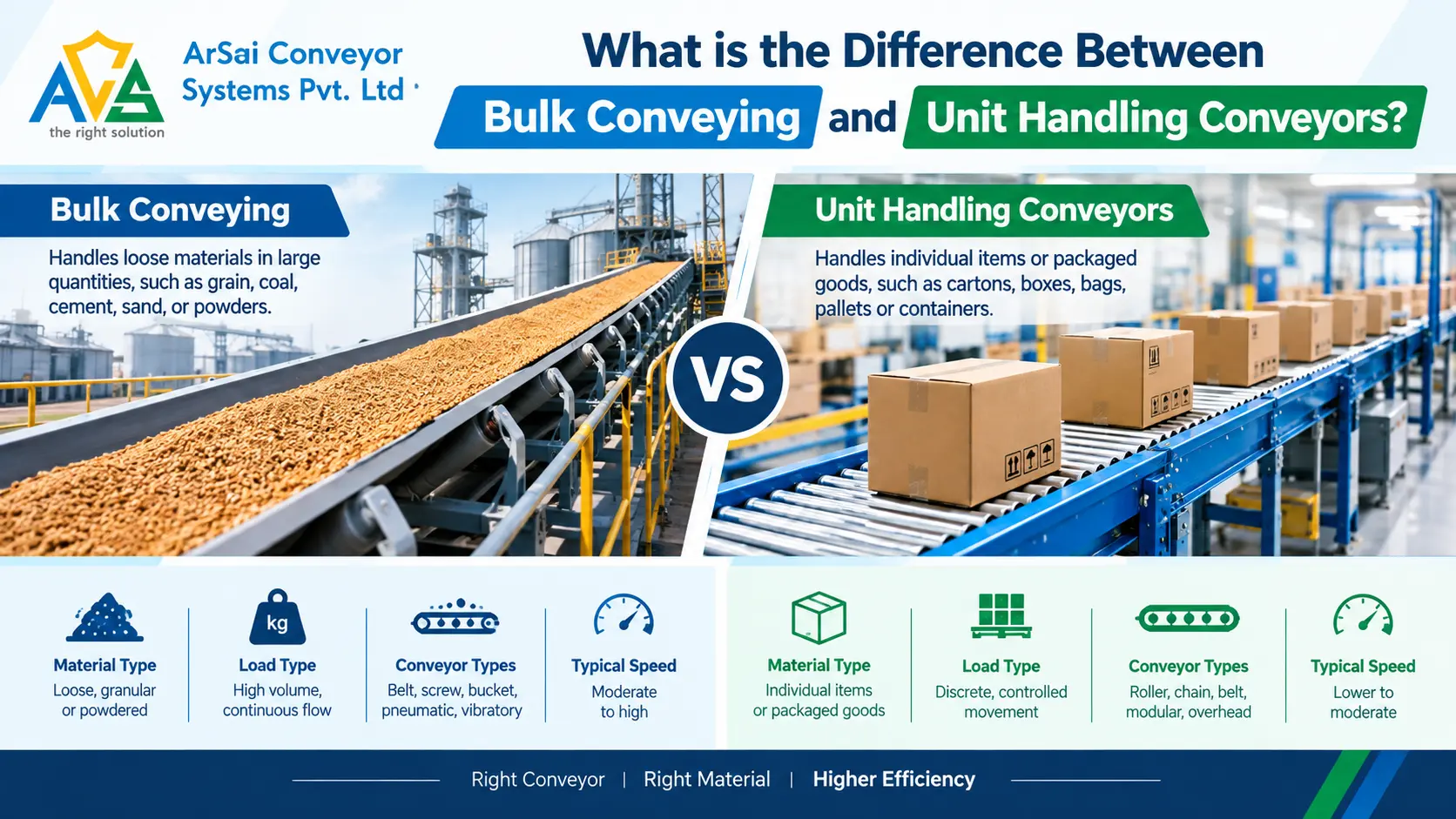
Conveyor systems play an important role in modern industries by improving material movement, reducing manual labour, and increasing operational efficiency. From manufacturing plants and warehouses to food processing facilities and construction industries, conveyors help transport materials safely and consistently. However, not every conveyor system is designed to handle the same type of material. Two major categories are bulk conveying and unit handling conveyors.
Understanding the difference between these systems helps businesses select the right conveyor solution according to their material type, production requirements, available space, and handling capacity. While bulk handling conveyors are designed to transport large quantities of loose materials, unit handling conveyors move individual items or packaged products from one location to another.
In this guide, we will explain how both conveyor systems work, their key differences, applications, advantages, and the factors to consider when choosing the right solution for your facility.
What Are Bulk Handling Conveyors?
Bulk handling conveyors are industrial material handling systems designed to transport large quantities of loose, unpackaged materials. These materials are generally moved continuously without being separated into individual units. Common examples include sand, coal, grains, cement, minerals, fertilisers, and other granular or powdered substances.
These conveyor systems are widely used in industries where raw materials must be transferred between processing stages, storage areas, loading points, and production equipment.
Depending on the material characteristics and operating conditions, bulk handling conveyors may use belts, screws, chains, buckets, or vibrating mechanisms to move materials efficiently.
Also Read: What Is a Pallet Conveyor? Types, Design, Working and Applications
Types of Bulk Handling Conveyors
1. Belt Conveyors
Belt conveyors are commonly used for transporting bulk materials over short or long distances. They are suitable for materials such as coal, sand, aggregates, grains, and other loose substances. Their continuous movement supports high-volume material transportation.
2. Screw Conveyors
Screw conveyors use a rotating helical screw inside a trough or enclosed tube to move materials. They are particularly useful for handling powders, granules, cement, and other materials that require controlled transportation.
3. Bucket Elevators
Bucket elevators move bulk materials vertically using a series of buckets attached to a belt or chain. They are frequently used in grain processing, agricultural facilities, and industrial storage applications.
4. Chain Conveyors
Chain-based systems can transport heavy or abrasive bulk materials in suitable industrial environments. Their design depends on the material properties, required capacity, and working conditions.
Advantages of Bulk Handling Conveyors
- High-volume transportation: Move large quantities of raw materials continuously.
- Reduced manual handling: Minimise labour requirements and repetitive material movement.
- Improved productivity: Maintain a steady supply of materials to production equipment.
- Flexible configurations: Support horizontal, inclined, or vertical transportation, depending on the conveyor type.
- Better process integration: Connect storage areas, processing machinery, and material loading systems.
What Are Unit Handling Conveyors?
Unit handling conveyors are designed to transport individual products, packages, components, or containers rather than loose materials. Each item remains identifiable as a separate unit while moving through the conveyor system.
These conveyors are widely used in manufacturing plants, warehouses, distribution centres, assembly lines, packaging facilities, and e-commerce operations. They help businesses move products between workstations, inspection points, packing areas, and dispatch sections.
Depending on the application, unit handling conveyors may use belts, rollers, chains, overhead tracks, or modular conveyor components.
Types of Unit Handling Conveyors
1. Belt Conveyors
Unit handling belt conveyors transport cartons, bags, components, packaged goods, and finished products. They offer a smooth conveying surface and are suitable for applications requiring consistent product movement.
2. Roller Conveyors
Roller conveyors use a series of rollers to move boxes, trays, pallets, and other products with suitable bases. They may operate through gravity or powered rollers, depending on the application.
3. Chain Conveyors
Chain conveyors are suitable for transporting heavy products, pallets, fixtures, and industrial components. They are commonly integrated into manufacturing and assembly operations.
4. Overhead Conveyors
Overhead conveyor systems move suspended products above the production floor. They are especially useful in garment manufacturing, automotive production, painting lines, and other applications where floor space needs to remain available for workers and equipment.
Advantages of Unit Handling Conveyors
- Organised product movement: Transport individual products between different operational stages.
- Improved workflow: Connect assembly, inspection, packaging, and dispatch areas.
- Space optimisation: Certain designs, such as overhead conveyors, free up valuable floor space.
- Better handling consistency: Help maintain controlled product movement and reduce unnecessary manual lifting.
- Automation compatibility: Can be integrated with sensors, barcode scanners, sorting equipment, and automated production lines.
Key Differences Between Bulk Conveying and Unit Handling Conveyors
Although both systems support industrial material transportation, their operating principles and applications differ.
| Comparison Factor | Bulk Handling Conveyors | Unit Handling Conveyors |
|---|---|---|
| Material type | Loose materials, powders, grains, and aggregates | Individual products, packages, components, and containers |
| Handling method | Continuous movement of bulk material | Movement of separate, identifiable items |
| Primary objective | Transport large quantities of raw materials | Transport products through production or distribution processes |
| Common examples | Belt, screw, and bucket elevators | Belt, roller, chain, and overhead conveyors |
| Typical applications | Mining, agriculture, cement, and grain processing | Warehousing, assembly, packaging, and manufacturing |
| Capacity measurement | Often tonnes per hour or volume per hour | Often items per minute, units per hour, or load weight |
| Product control | Focuses on material flow and discharge | Focuses on item positioning, spacing, and routing |
| System design | Depends on bulk density, particle size, moisture, and flow behaviour | Depends on item dimensions, weight, shape, and handling requirements |
The main distinction is that bulk conveying focuses on the continuous movement of loose materials, whereas unit handling focuses on the controlled movement of individual products.
Bulk Conveying vs Unit Handling: How Do You Choose?
Selecting the right conveyor system requires a clear understanding of your operational requirements. The most suitable solution depends on what you are moving, how much material you need to transport, and how the conveyor will fit into your production process.
1. Identify the Material or Product
Start by identifying whether your operation involves loose raw materials or separate products. Bulk handling conveyors are generally appropriate for grains, powders, minerals, and aggregates. Unit handling conveyors are better suited to cartons, manufactured components, bags, containers, and finished goods.
Some materials, such as filled bags, are handled as individual units, while the same material in loose form may require a bulk conveying system.
2. Evaluate Capacity Requirements
Bulk conveying systems are often selected according to the required mass or volume flow rate. Unit handling systems are generally evaluated by the number of items transported per hour, individual load weight, and required spacing.
Accurate capacity calculations help prevent bottlenecks and ensure the conveyor meets production targets.
3. Consider Layout and Available Space
The facility layout influences conveyor selection. Horizontal, inclined, vertical, and overhead configurations can support different transportation requirements. For example, an overhead conveyor may be useful where floor space is limited, while a bucket elevator can support vertical movement of suitable bulk materials.
4. Assess Material and Product Characteristics
For bulk materials, consider particle size, abrasiveness, moisture content, temperature, dust generation, and flow behaviour. For unit handling, evaluate product dimensions, weight, shape, packaging, fragility, and stability during movement.
These characteristics influence conveyor construction, belt or roller selection, drive requirements, and safety provisions.
5. Review Automation and Maintenance Needs
Consider whether the system must connect with production machinery, sensors, sorting equipment, or automated packaging lines. Also evaluate cleaning requirements, maintenance access, energy consumption, and expected operating hours.
A properly selected conveyor system can improve efficiency while reducing avoidable downtime and operating costs.
Applications of Bulk Handling and Unit Handling Conveyors
Industries Using Bulk Handling Conveyors
Bulk handling conveyors are commonly used in:
- Mining and mineral processing: Moving coal, ores, and extracted materials.
- Cement manufacturing: Transporting cement ingredients, clinker, and other bulk materials.
- Agriculture: Handling grains, seeds, and agricultural products.
- Food processing: Moving suitable granular ingredients and raw materials.
- Chemical and fertiliser industries: Transporting compatible powders and granules with appropriate containment and safety measures.
Industries Using Unit Handling Conveyors
Unit handling conveyors are widely used in:
- Automotive manufacturing: Moving components and assemblies between workstations.
- Warehousing and logistics: Transporting cartons, parcels, and packaged products.
- Garment manufacturing: Moving garments through production and finishing stages.
- Packaging industries: Connecting filling, labelling, inspection, and packing operations.
- Electronics manufacturing: Handling components and assembled products under suitable operating conditions.
Can Bulk Conveying and Unit Handling Systems Work Together?
Yes. Many industrial facilities use both systems as part of an integrated material handling process.
For example, a food processing facility may use bulk handling conveyors to transport grains or other raw ingredients before processing. Once the products are processed, packed into bags or cartons, and prepared for dispatch, unit handling conveyors can transport the finished packages to inspection, storage, and shipping areas.
Similarly, manufacturing plants may use bulk conveyors to supply raw materials to production equipment and unit handling systems to move components or finished products between workstations.
Integrating the two systems can improve workflow continuity, reduce unnecessary material transfers, and support better coordination between production and packaging operations.
Why Choose ArSai Conveyor Systems Pvt. Ltd.?
Choosing a suitable conveyor solution requires more than selecting a conveyor type. The system must match your material characteristics, production volume, facility layout, and long-term operational goals.
ArSai Conveyor Systems Pvt. Ltd. can be considered when evaluating conveyor solutions for industrial material movement and production workflows. Before finalising a system, businesses should assess load capacity, conveyor dimensions, operating speed, drive configuration, safety requirements, maintenance access, and compatibility with existing equipment.
A well-planned conveyor installation can help improve material flow, support consistent production, and reduce dependence on manual transportation. Discussing your application requirements with a conveyor specialist can help identify an appropriate configuration for your facility.
Frequently Asked Questions (FAQs)
1. What is the main difference between bulk conveying and unit handling conveyors?
Bulk conveying systems transport loose materials such as grains, sand, powders, and minerals. Unit handling conveyors transport individual items such as cartons, boxes, components, and packaged products.
2. Which conveyor is suitable for transporting heavy materials?
The appropriate conveyor depends on whether the material is loose or handled as an individual load. Heavy loose materials may require a suitably designed bulk conveyor, while heavy products or pallets may need a heavy-duty unit handling conveyor.
3. Are belt conveyors used for both bulk and unit handling?
Yes. Belt conveyors can transport loose bulk materials or individual products. The belt design, conveyor structure, loading method, and operating specifications vary according to the application.
4. Which industries use unit handling conveyors?
Warehousing, automotive manufacturing, garment production, electronics, packaging, and distribution industries commonly use unit handling conveyors to move products efficiently.
5. How do I select the right industrial conveyor system?
Evaluate material type, load weight, required capacity, transportation distance, layout, operating conditions, safety requirements, and automation needs before selecting a conveyor system.
Conclusion
Bulk conveying and unit handling conveyors perform different but equally important roles in industrial material movement. Bulk handling conveyors are designed for the continuous transportation of loose materials, while unit handling conveyors move individual products through manufacturing, packaging, storage, and distribution processes.
Understanding these differences helps businesses select equipment that matches their operational needs, improves workflow efficiency, and supports reliable material transportation. For the best results, evaluate your material characteristics, capacity requirements, facility layout, and future production plans before investing in a conveyor system.