
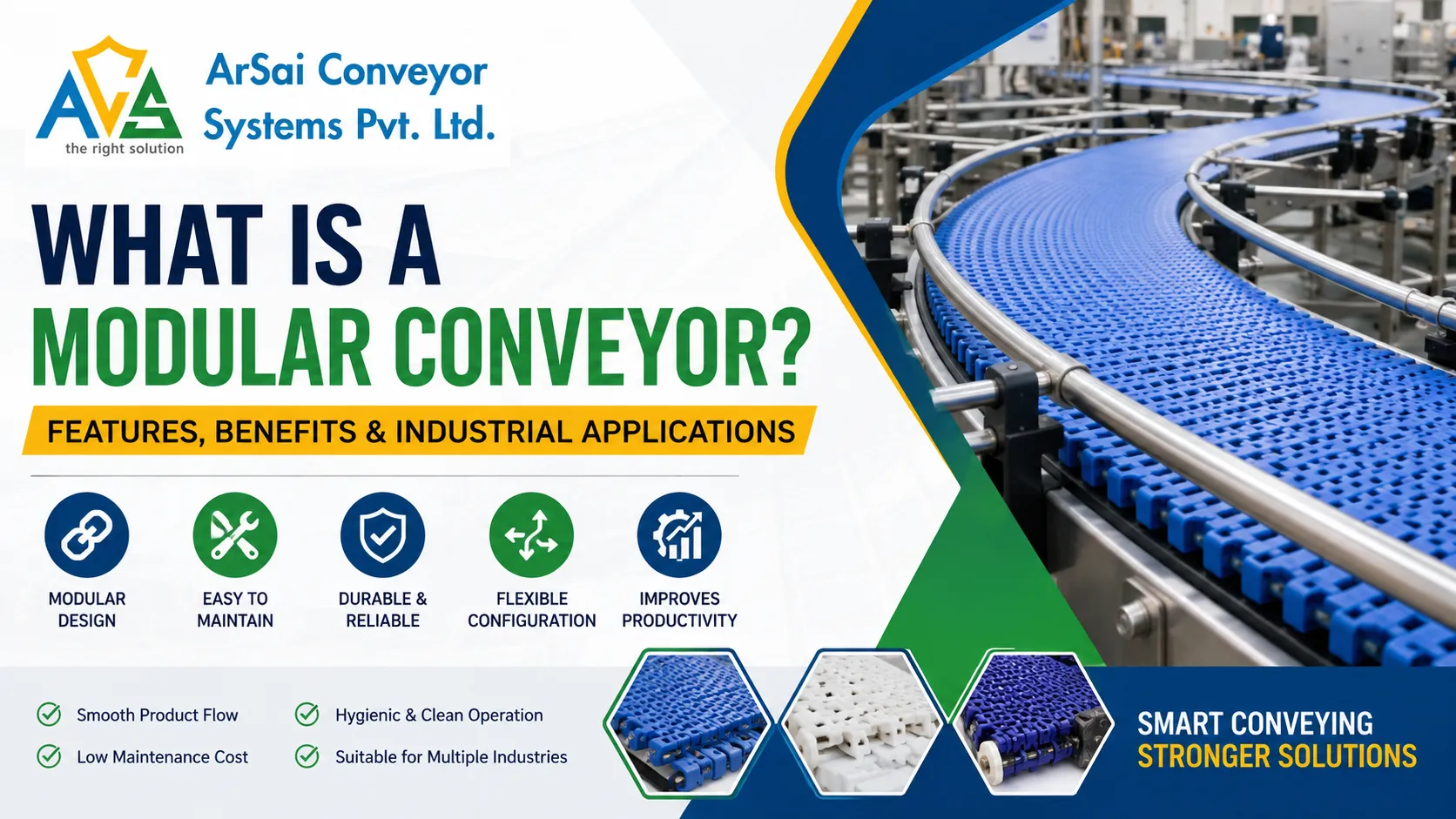
Modern manufacturing and material-handling operations require conveyor systems that can move products smoothly, safely, and consistently. From food processing and packaging to automotive, logistics, and general manufacturing, conveyors help reduce manual handling and improve production efficiency. Among the many conveyor technologies available today, the modular conveyor has become a popular choice because of its flexibility, easy maintenance, and adaptable design.
A modular conveyor uses interconnected belt modules that can be assembled, removed, or replaced as required. This construction makes it different from conventional continuous belts and allows the conveyor to be configured for straight, curved, inclined, and other material-handling applications.
ArSai Conveyor Systems Pvt. Ltd. provides conveyor solutions for different industrial requirements, helping manufacturers select systems according to product type, layout, speed, load, and production conditions.
What Is a Modular Conveyor?
A modular conveyor is a material-handling system that uses a belt made from individual interlocking modules. These modules are connected using rods or similar joining mechanisms to create a continuous conveying surface.
The modular construction allows individual belt sections to be removed and replaced instead of replacing an entire belt. This can simplify maintenance and reduce downtime when a particular section becomes damaged or worn.
Unlike traditional conveyor belts that are commonly supplied as continuous flexible belts, modular systems are assembled from multiple pieces. This makes them highly adaptable for industrial layouts where conveyors need to include curves, transfers, inclines, or specialized conveying sections.
The design of a conveyor modular system can also be customized according to the product being transported and the operating environment.
Also Read: Chain Conveyor vs Belt Conveyor: Complete Comparison Guide
How Does a Modular Conveyor Work?
The working principle of a modular conveyor is relatively straightforward. An electric motor drives a sprocket or drive mechanism connected to the modular belt. As the sprocket rotates, it engages with the belt modules and moves the belt along the conveyor frame.
Products placed on the conveying surface travel from the loading point to the required discharge location.
Depending on the application, the system can include components such as:
- Modular belt
- Drive motor
- Gearbox
- Sprockets
- Conveyor frame
- Support rollers or wear strips
- Side guides
- Tensioning arrangement
- Control system
The belt continuously travels around the conveyor structure, returning underneath after passing over the discharge end.
Because the belt is positively driven by sprockets, modular conveyors can provide reliable movement for many industrial applications.
What Is a Plastic Conveyor Belt?
A plastic conveyor belt is a modular conveying surface generally manufactured using engineered plastic materials. It consists of individual plastic modules that interlock to create a continuous belt.
Plastic modular belts can be designed with different surface patterns depending on the application. Some have smooth surfaces for general conveying, while others may have textured, perforated, raised-rib, or specialized surfaces.
One of the major advantages of a plastic conveyor belt is that individual modules can be replaced when required. This can make maintenance more convenient compared with replacing an entire conventional belt.
Plastic modular belts are widely used in industries where hygiene, washdown capability, corrosion resistance, or product handling flexibility is important.
Modular Conveyor vs Conventional Belt Conveyor
Both modular and conventional conveyor systems can be used for material handling, but their construction and maintenance characteristics are different.
Traditional belt conveyors generally use a continuous belt made from materials such as rubber, PVC, PU, or other flexible compounds. Modular conveyors use interlocking belt modules.
If a conventional belt becomes significantly damaged, replacing the belt may require more extensive work. With a modular design, a damaged section can often be removed and replaced without changing the complete belt.
Another difference is flexibility. Modular belt conveyors can be designed for certain curves and specialized layouts more easily, depending on the belt construction and conveyor design.
The right option depends on factors such as product characteristics, conveying distance, hygiene requirements, operating temperature, load, speed, and available space.
Key Benefits of Modular Belt Conveyors
Easy Maintenance
One of the biggest advantages of modular belt conveyors is their maintainability. Since the belt consists of individual modules, damaged sections can be replaced without necessarily changing the complete belt.
This can help reduce maintenance time and make repairs more manageable.
Flexible Design
Modular conveyor systems can be designed for different layouts. Depending on the belt type, they can accommodate straight runs, curves, inclines, and other configurations.
This flexibility can be useful when production facilities have limited floor space.
Durable Construction
Modular belts are designed for industrial operation and can be selected according to the load, product characteristics, and working environment.
The appropriate belt material and construction can improve service performance under demanding conditions.
Improved Product Handling
Different belt surfaces can be selected for different products. This helps manufacturers handle boxes, containers, packaged products, components, food products, and other materials more effectively.
Reduced Belt Replacement Complexity
Because the belt is modular, maintenance teams can work on specific sections rather than automatically replacing the entire belt.
Suitable for Washdown Applications
Certain plastic modular belt designs are suitable for applications requiring frequent cleaning. This makes them particularly useful in industries where hygiene and washdown are important considerations.
Applications of Modular Conveyors
The versatility of the modular conveyor makes it suitable for a wide range of industries.
Food Processing
Modular conveyors are widely used for transporting packaged and processed food products. Depending on the belt material and design, they can be selected for applications requiring regular cleaning.
Packaging Industry
Boxes, cartons, bottles, containers, and packaged goods can be transported using modular systems. Their flexible configuration makes them useful for connecting different packaging stages.
Beverage Industry
Bottles, cans, trays, and containers can be conveyed through filling, inspection, packaging, and handling processes.
Pharmaceutical Industry
Modular conveyor systems can be used for moving containers, cartons, packages, and other products through different production and packaging stages.
Automotive Manufacturing
Components and assembled parts can be transported between different workstations, assembly operations, inspection areas, and storage points.
Logistics and Warehousing
Modular conveyors can support the movement of packages, boxes, and containers within warehouses, distribution centers, and material-handling facilities.
Types of Modular Conveyor Belts
Different modular belt designs are available to meet specific application requirements.
Flat Top Modular Belt
Flat-top belts provide a relatively smooth conveying surface and are suitable for general product transportation.
Perforated Modular Belt
Perforated designs allow air, water, or other materials to pass through the belt surface. They can be useful in applications involving washing, cooling, or drainage.
Cleated Modular Belt
Cleats provide additional support for products moving on inclined conveyors. They can help prevent products from sliding backward.
Raised-Rib Belt
Raised surfaces can improve product grip and handling for specific applications.
Curved Modular Belt
Certain modular belt designs can be configured for curved conveyor layouts, helping manufacturers optimize available production space.
The appropriate belt type should be selected according to product dimensions, weight, surface characteristics, conveyor angle, speed, and environmental conditions.
How to Choose the Right Modular Conveyor?
Selecting a conveyor should begin with understanding the actual material-handling requirement.
Product Characteristics
Consider product size, weight, shape, surface, fragility, and packaging. A belt suitable for cartons may not be ideal for loose or delicate products.
Conveyor Speed
Required production output determines the appropriate conveyor speed. Excessive speed may affect product stability, while insufficient speed can restrict production capacity.
Conveyor Length and Layout
The available floor area and distance between processing stations influence conveyor dimensions and configuration.
Load Capacity
The conveyor frame, belt, drive system, sprockets, and supporting components should be selected according to the expected load.
Operating Environment
Temperature, moisture, dust, chemicals, cleaning methods, and hygiene requirements should all be considered.
Belt Material
The material of the modular belt should match the product and working conditions. Plastic modular belts are available in different material options for different industrial requirements.
Maintenance of a Modular Conveyor
Although modular systems are designed for convenient maintenance, regular inspection is still important.
Operators should check belt modules, sprockets, drive components, support surfaces, bearings, motor, gearbox, and other moving components. Loose or damaged parts should be addressed promptly.
Cleaning should be performed according to the belt manufacturer’s recommendations, particularly in food, pharmaceutical, and other hygiene-sensitive applications.
Proper alignment is also important. An incorrectly aligned belt can create uneven wear and affect conveying performance.
Regular lubrication may be required for specific mechanical components, although the exact maintenance requirements depend on the conveyor design.
Why Choose ArSai Conveyor Systems Pvt. Ltd.?
ArSai Conveyor Systems Pvt. Ltd. provides industrial conveyor solutions designed around individual material-handling requirements. Every manufacturing facility has a different production layout, product type, throughput requirement, and operating environment.
A professionally designed modular conveyor can help connect production stages, reduce manual movement, improve workflow, and create a more organized material-handling process.
The selection of belt type, conveyor dimensions, drive arrangement, speed, frame construction, and additional accessories should be based on the actual application.
Conclusion
A modular conveyor is a flexible material-handling solution that uses interlocking belt modules to transport products efficiently. Its modular construction makes maintenance easier, while different belt configurations allow the system to handle a wide range of industrial products.
From food and beverage processing to packaging, automotive, pharmaceutical, warehousing, and general manufacturing, modular belt conveyors can be adapted to many production environments.
A properly selected plastic conveyor belt can provide advantages such as durability, easy replacement, flexible configuration, and suitability for applications where cleaning and hygiene are important.
However, choosing the right system requires more than simply selecting a conveyor based on belt size. Product characteristics, load, speed, layout, operating environment, cleaning requirements, and production capacity should all be considered.
With the right engineering and configuration, a conveyor modular system can become an important part of an efficient and reliable industrial material-handling setup. ArSai Conveyor Systems Pvt. Ltd. can help businesses evaluate their requirements and select suitable conveyor solutions for their specific production applications.