
In modern manufacturing, moving products from one workstation to another efficiently is just as important as the production process itself. When different operations require different processing times, a conventional conveyor may not provide enough flexibility. This is where a power and free conveyor system becomes a practical material handling solution.
Designed to support controlled product movement, these conveyor systems allow individual loads to stop, accumulate, and move forward without necessarily stopping the entire conveyor line. They are particularly useful in manufacturing facilities where products pass through multiple assembly, inspection, finishing, or storage stages.
In this guide, we will explain what a power and free conveyor system is, how it works, its major benefits, and where industries commonly use it.
What Is a Power and Free Conveyor System?
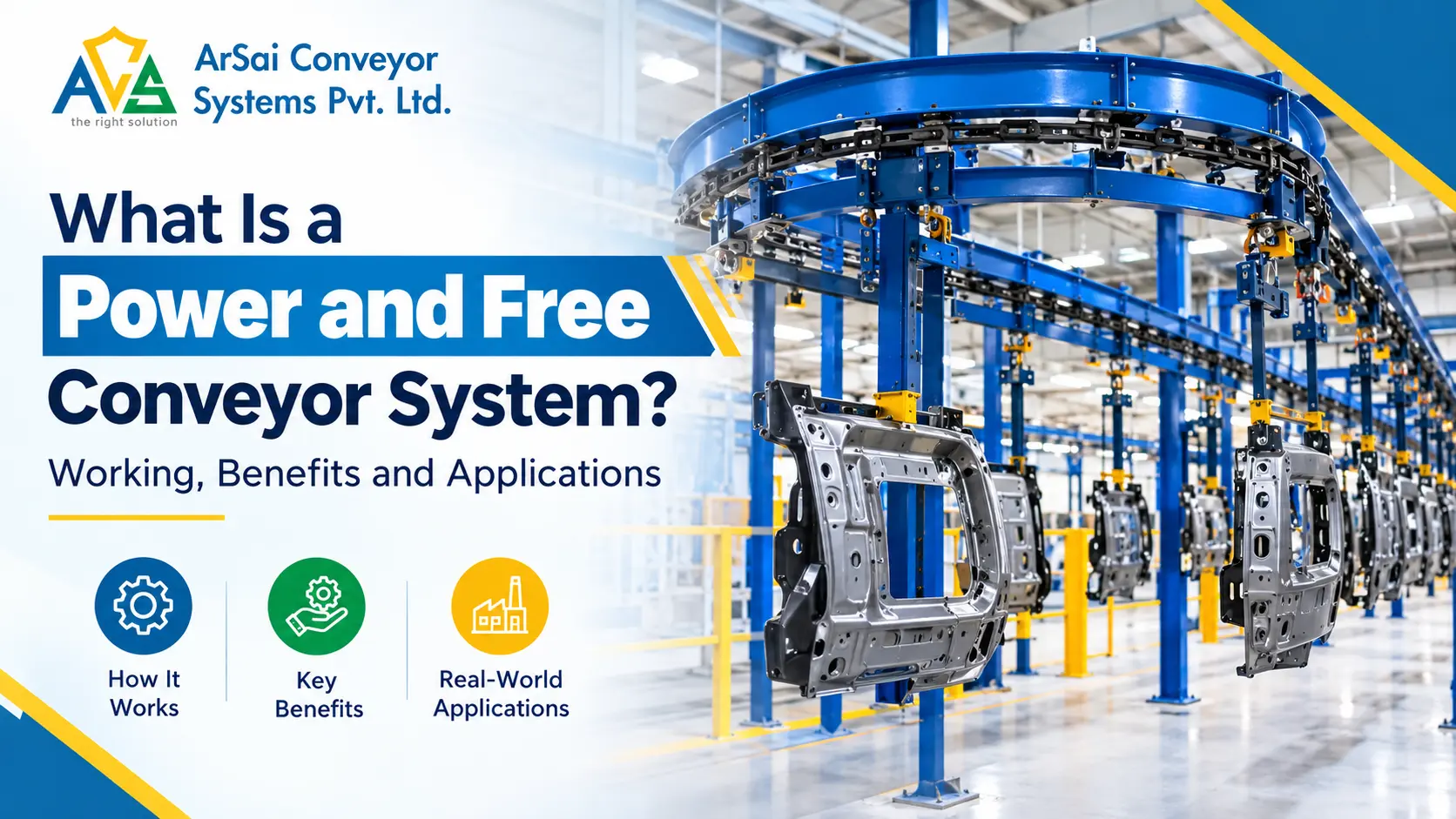
A power and free conveyor system is an industrial material handling solution that uses separate powered and load-carrying tracks to transport products through a production facility.
Unlike a conventional conveyor, where loads generally move at a fixed speed and sequence, a power and free conveyor allows greater control over individual carriers. Products can be held at designated stations, accumulated in buffer areas, or diverted to different production routes according to operational requirements.
The system typically consists of two tracks:
- Power track: Contains the continuously moving drive chain that provides the force required to transport carriers.
- Free track: Supports individual trolleys or carriers that hold products and can stop or move independently of the continuously running drive chain.
This arrangement makes power and free overhead conveyors suitable for complex production environments where different products may require different processing times.
How Does a Power and Free Conveyor System Work?
The working principle of a power and free conveyor system involves the coordinated movement of a powered chain and individual load carriers.
First, products are placed on carriers designed according to their size, weight, and handling requirements. The powered chain moves along its designated track, engaging the carriers through mechanical pusher mechanisms.
As carriers travel through the facility, they may reach assembly stations, inspection points, processing areas, or accumulation zones.
When a carrier reaches a controlled stop, its engagement mechanism disengages from the moving chain. The carrier remains stationary while the powered chain continues moving. Once the workstation is ready, the stop mechanism releases the carrier, allowing it to reconnect with the drive chain and continue along the conveyor route.
Switches and transfer mechanisms can also direct carriers toward different sections of the production line.
This independent movement allows manufacturers to manage production flow more effectively without requiring every workstation to operate at precisely the same speed.
Also Read: What Is the Difference Between Bulk Conveying and Unit Handling Conveyors?
Key Benefits of Power and Free Conveyor Systems
1. Flexible Production Flow
One of the biggest advantages of a power and free conveyor system is its ability to accommodate different production requirements.
For example, one assembly station may require additional time to complete a task, while another workstation may process products more quickly. The conveyor can hold products temporarily at designated locations while allowing other carriers to continue moving.
This flexibility helps manufacturers manage changing production schedules, product variations, and different processing times.
2. Reduced Production Interruptions
In conventional conveyor systems, a blockage at one workstation may affect the movement of products throughout the line.
Power and free conveyors help reduce this dependency by allowing individual carriers to stop independently. Products can accumulate in suitable buffer sections until downstream operations are ready.
This capability supports better production continuity, although overall performance still depends on conveyor capacity, workstation availability, and system design.
3. Better Utilisation of Factory Space
A power and free overhead conveyor uses elevated tracks to transport products above the production floor.
This can help preserve valuable floor space for machinery, assembly stations, operators, and other material handling activities.
Depending on the facility layout, the conveyor may travel through different elevations or connect workstations located across a large manufacturing area.
4. Controlled Product Routing
Manufacturing facilities often produce different models, sizes, or product variations on the same line.
A power and free conveyor system can incorporate switches and transfer mechanisms to direct carriers toward different production routes. This is useful when certain products require additional inspection, specialised assembly, or separate finishing operations.
Controlled routing helps create a more adaptable material handling process.
5. Support for Industrial Automation
Power and free overhead conveyors can be integrated with suitable sensors, programmable logic controllers (PLCs), and automated equipment.
These controls can coordinate carrier stops, releases, transfers, and workstation operations. Depending on the system configuration, manufacturers can also incorporate tracking and production sequencing functions.
Such integration helps connect conveyor movement with the wider manufacturing workflow.
Applications of Power and Free Conveyor Systems
Power and free conveyors are used in industries where products need controlled movement between multiple production stages.
Automotive Manufacturing
Automotive plants handle vehicle bodies, chassis, engines, and components that may require several assembly and finishing operations.
A power and free conveyor can transport these products between workstations, paint shops, inspection areas, and assembly sections. Its controlled stopping and routing capabilities make it suitable for production lines with varying cycle times.
Paint Shops and Surface Finishing
Painting, coating, drying, and curing operations often require products to remain in a particular area for a specified processing period.
Power and free conveyors can hold carriers at designated locations or move them through different finishing stages. The system layout must account for process conditions, product clearances, and the requirements of the finishing equipment.
General Manufacturing and Assembly
Manufacturers of industrial equipment, machinery, and consumer products may use power and free conveyor systems to move components between assembly stations.
The system can support work-in-process accumulation, inspection, component handling, and product transfers where independent carrier movement is beneficial.
Warehousing and Material Handling
In suitable facilities, power and free conveyors can connect production areas with staging, storage, or dispatch operations.
They can help manage the movement of products through defined routes while reducing unnecessary handling between connected processes.
Power and Free Conveyor vs Conventional Overhead Conveyor
The primary difference between a power and free conveyor and a conventional continuously moving overhead conveyor is the degree of control over individual loads.
A conventional overhead conveyor generally moves carriers continuously along a fixed route. A power and free conveyor provides additional control through separate power and free tracks, allowing carriers to stop, accumulate, and follow different routes where the system is designed for it.
For manufacturing facilities with simple, uniform transport requirements, a conventional overhead conveyor may be sufficient. For complex assembly lines with variable processing times, accumulation requirements, or multiple routing options, a power and free conveyor may provide greater operational flexibility.
The appropriate choice depends on product weight, production volume, plant layout, process sequence, and automation requirements.
How to Choose the Right Power and Free Conveyor System
Before selecting a power and free conveyor system, manufacturers should evaluate the following factors:
- Load characteristics: Consider product weight, dimensions, centre of gravity, and carrier requirements.
- Production requirements: Evaluate conveyor speed, processing time, accumulation capacity, and expected throughput.
- Plant layout: Check available overhead clearance, structural support, workstation locations, and transfer points.
- Routing requirements: Identify whether products need alternate routes, buffering, or controlled stopping.
- Automation compatibility: Determine how the conveyor will coordinate with sensors, PLCs, and existing production equipment.
- Maintenance and safety: Consider accessibility, inspection requirements, operator safety, and long-term service support.
A well-planned system should meet current production requirements while allowing practical adjustments as manufacturing needs change.
Conclusion
A power and free conveyor system offers manufacturers greater control over product movement, accumulation, and routing. Its ability to separate the movement of the powered chain from individual load carriers makes it a useful solution for automotive manufacturing, industrial assembly, paint shops, and other complex material handling applications.
ArSai Conveyor Systems Pvt. Ltd. provides power and free conveyor solutions for industrial material handling requirements. Businesses evaluating a conveyor installation can consider their product characteristics, production workflow, layout, and automation needs to identify a suitable system configuration.
For more information about power and free conveyor systems, explore the Power and Free Conveyor System solutions offered by ArSai Conveyor Systems.