
Modern industries are continuously looking for faster, safer, and more efficient ways to move products and materials from one point to another. Conveyor systems have become an essential part of warehouses, manufacturing plants, distribution centers, packaging facilities, and logistics operations. Among the different conveyor technologies available today, powered conveyor rollers offer an efficient solution for handling cartons, boxes, pallets, totes, and other unit loads.
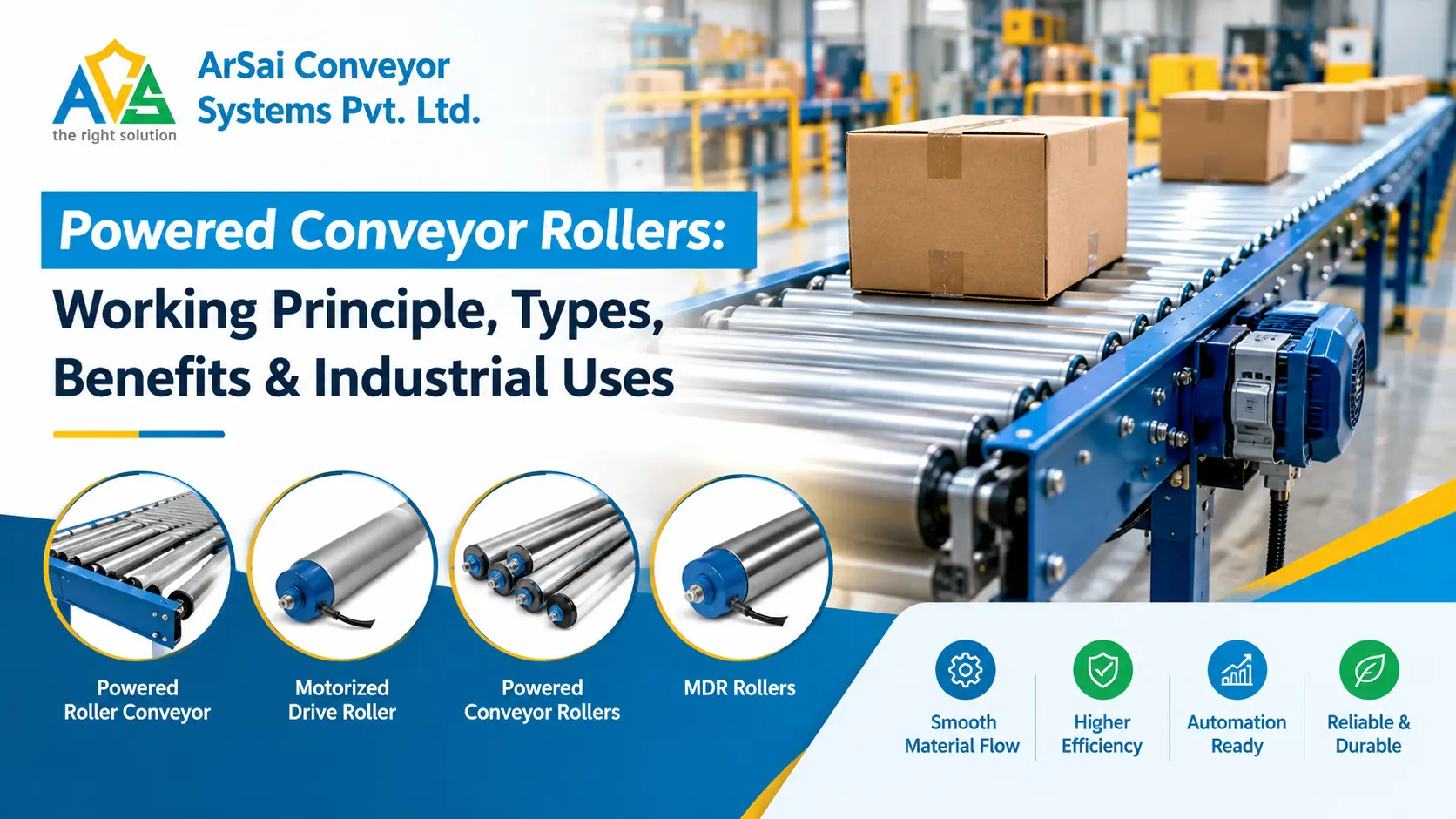
A powered roller conveyor uses mechanically driven rollers to move products along a defined path with less manual effort. Depending on the application, the system can be designed with conventional drives or MDR rollers, also known as motorized drive rollers. These systems provide controlled movement and can be integrated with sensors, automation systems, and warehouse management technologies.
In this guide, we will understand the working principle, types, benefits, and industrial uses of powered roller conveyor systems.
What Is a Powered Roller Conveyor?
A powered roller conveyor is a material-handling system in which rollers are mechanically driven to transport products. Unlike gravity roller conveyors, where goods move because of gravity or manual pushing, powered systems actively generate the force required to move the load.
The rollers are installed within a conveyor frame and connected to a suitable drive mechanism. Depending on the design, power may be transferred through chains, belts, sprockets, or individual motorized rollers.
Powered roller conveyors are particularly useful when products need to travel over longer distances, move at controlled speeds, accumulate at specific points, or handle heavier loads.
Also Read: What Is a Modular Conveyor? Complete Guide to Modular Belt Conveyor Systems
Working Principle of Powered Conveyor Rollers
The working principle of powered conveyor rollers is relatively straightforward. An electric motor supplies mechanical power, which is transferred to the conveyor rollers through an appropriate drive arrangement.
When the system is switched on, the drive mechanism rotates the powered rollers. The rotating surface of the rollers comes into contact with the bottom of the product placed on the conveyor. Friction between the roller and product creates the force required to move the product forward.
In a conventional system, one powered roller can transmit motion to other rollers through chains or belts. In modern conveyor designs, an MDR roller may contain a compact motor and gearbox inside the roller itself. This allows individual conveyor zones to be powered independently.
Sensors can also be incorporated into the system. When a product reaches a particular zone, the sensor detects its presence and the control system can start, stop, or slow the corresponding rollers. This makes the conveyor suitable for automated material-handling operations.
What Is a Motorized Drive Roller?
A motorized drive roller, commonly called an MDR roller, is a conveyor roller with an integrated motor and gearbox. Instead of using a large external motor to drive several rollers, the motor is housed inside the roller.
MDR technology is popular in automated conveyor systems because individual zones can be controlled independently. This allows products to accumulate without necessarily requiring the entire conveyor to run continuously.
The compact design of a motorized drive roller also helps reduce the number of external drive components, making the conveyor cleaner and easier to integrate into automated material-handling systems.
Types of Powered Roller Conveyors
Different applications require different conveyor configurations. Some commonly used types include:
1. Chain-Driven Roller Conveyor
In chain-driven systems, power is transmitted from a motorized drive unit to the rollers using chains and sprockets. These conveyors are well suited for heavy-duty applications such as pallet handling and industrial manufacturing.
2. Belt-Driven Roller Conveyor
Here, a belt transfers power from the drive unit to multiple rollers. Belt-driven systems can provide smooth product movement and are suitable for handling cartons, boxes, and other unit loads.
3. Line Shaft Roller Conveyor
A line shaft conveyor uses a rotating shaft positioned below the rollers. Spools and belts transfer motion from the shaft to individual rollers. These systems are often used for lightweight packages and applications requiring gentle handling.
4. MDR Roller Conveyor
MDR conveyors use MDR rollers, where the motor and gearbox are integrated within the roller. Each zone can be independently controlled, making this technology suitable for accumulation, sorting, scanning, and automated warehouse applications.
5. Flexible Powered Roller Conveyor
Flexible powered roller conveyors can be expanded, contracted, or repositioned according to operational requirements. They can be useful in loading, unloading, packaging, and temporary material-handling applications.
Key Benefits of Powered Roller Conveyors
Efficient Material Movement
Powered systems automatically move products, reducing the need for manual pushing and handling. This can improve material flow and overall operational efficiency.
Controlled Speed
The conveyor speed can be selected according to the product, process requirements, and layout. Controlled movement is especially valuable in packaging, inspection, sorting, and assembly operations.
Suitable for Different Loads
Depending on the roller diameter, frame construction, motor capacity, and conveyor configuration, powered systems can handle everything from small cartons to heavy pallets.
Easy Automation Integration
Sensors, programmable controls, barcode scanners, weighing systems, and other automation technologies can be integrated with modern conveyor systems.
Reduced Manual Handling
Automating product movement can reduce repetitive manual tasks and help create a more organized material-handling environment.
Zone-Based Accumulation
MDR-based systems can divide the conveyor into independently controlled zones. Products can stop and accumulate without requiring the entire conveyor line to remain continuously powered.
Scalable Design
Powered roller conveyors can be designed in straight sections, curves, merges, transfers, and other configurations to suit the available space and material flow requirements.
Industrial Uses of Powered Roller Conveyors
Powered roller conveyor systems are used across numerous industries because of their versatility and ability to handle different types of unit loads.
Warehousing and Distribution
Distribution centers use powered conveyors to transport cartons, packages, totes, and parcels between storage, picking, sorting, and dispatch areas.
Manufacturing Plants
In manufacturing facilities, conveyors can move components and finished products between workstations, assembly areas, inspection stations, and packaging lines.
E-Commerce Fulfillment
E-commerce warehouses require fast and organized product movement. Powered roller conveyors can be integrated with sorting and order fulfillment systems to improve the movement of packages.
Packaging Industry
Products can be transported between filling, labeling, sealing, inspection, and packing stations with controlled movement.
Automotive Industry
Heavy components, assemblies, and containers can be transported through different production stages using appropriately designed powered roller systems.
Food and Beverage Industry
Powered conveyor systems can be used for moving packaged products, crates, cartons, and containers across processing and distribution areas. Conveyor construction and components should be selected according to the required hygiene and operating conditions.
Powered Roller Conveyor vs Gravity Roller Conveyor
The main difference is how the rollers receive their driving force. A gravity roller conveyor depends on gravity or manual pushing, whereas a powered roller conveyor uses a motorized drive system.
Powered systems are generally more suitable when controlled speed, automated movement, longer conveyor routes, frequent starts and stops, or heavier loads are required. Gravity conveyors, on the other hand, can be a simpler option for applications where powered movement is not necessary.
How to Choose the Right Powered Conveyor System?
Before selecting powered conveyor rollers, manufacturers should consider several factors, including:
- Product weight and dimensions
- Required conveyor speed
- Roller diameter and spacing
- Conveyor length and width
- Type of product being transported
- Required load capacity
- Accumulation requirements
- Available power supply
- Automation and control requirements
- Operating environment
For MDR applications, factors such as zone length, motor capacity, control architecture, and communication requirements should also be evaluated.
Conclusion
Powered conveyor rollers provide an effective way to automate product movement across manufacturing, warehousing, packaging, logistics, and distribution environments. From conventional chain- and belt-driven systems to advanced MDR rollers, different technologies can be selected according to load requirements, speed, automation level, and application conditions.
A properly designed powered roller conveyor can improve material flow, reduce manual handling, support automation, and provide controlled product movement. With the right configuration and components, these systems can become an important part of an efficient industrial material-handling operation.
ArSai Conveyor Systems Pvt. Ltd. focuses on developing practical conveyor solutions designed around specific industrial requirements, helping businesses achieve smoother and more organized material movement.