
Material handling plays an important role in modern manufacturing, warehousing and distribution operations. When products or heavy loads need to be moved from one workstation to another, manual handling can take considerable time and effort. This is where a pallet conveyor system provides a practical solution.
A pallet conveyor is designed to transport palletized products safely and efficiently across a facility. Depending on the application, the system can include straight conveyors, transfer sections, accumulation zones, rotating units and automated controls.
In this guide, we will explain what is a pallet conveyor, how it works, its major types, design considerations and common industrial applications.
What Is a Pallet Conveyor?
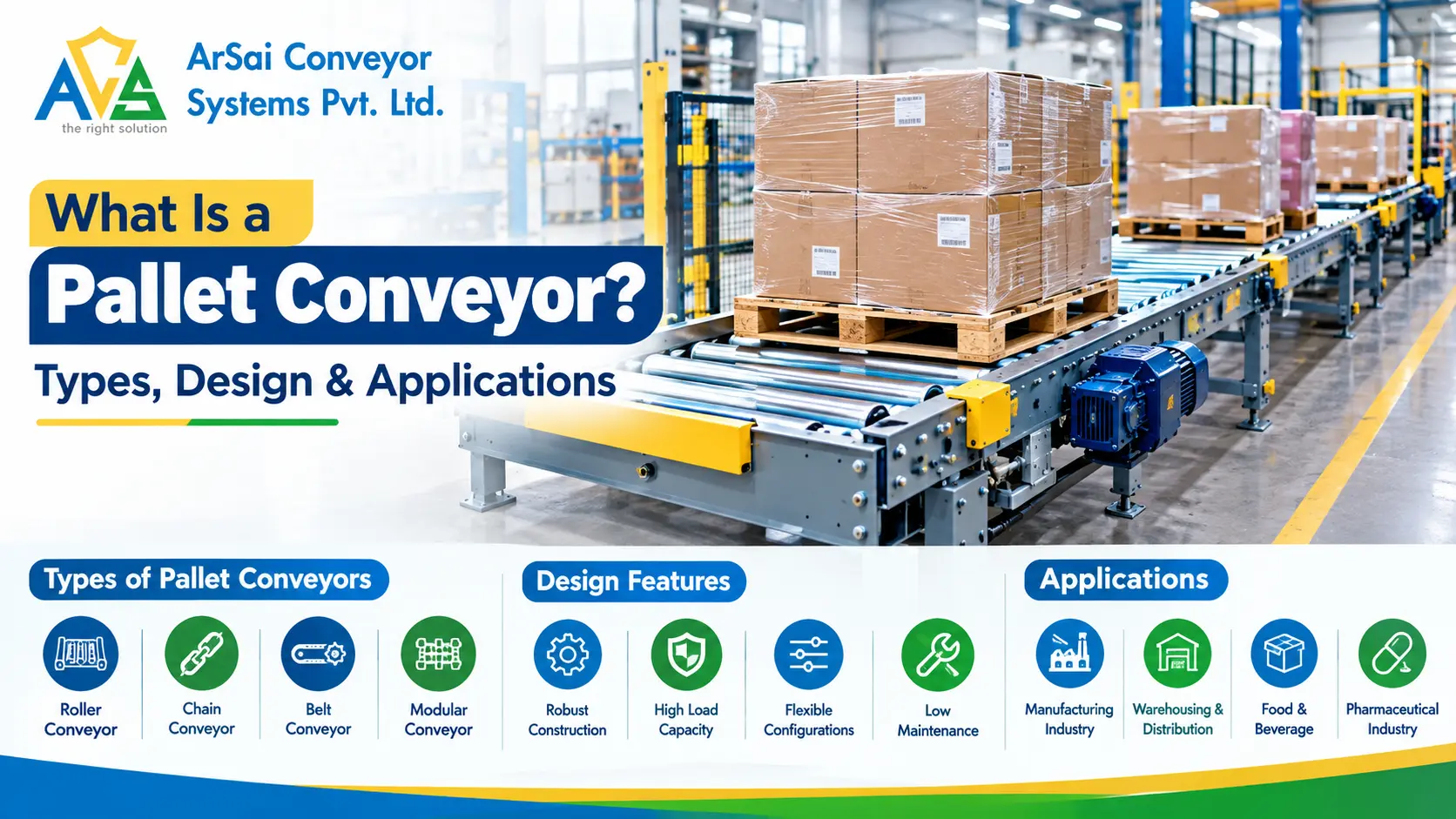
A pallet conveyor is a mechanical material-handling system used to move pallets containing goods, components, cartons or other loads from one location to another. It can be designed for continuous transportation, accumulation, sorting, transferring or positioning of pallets.
Unlike conventional conveyors used for lighter packages, pallet conveyors are generally designed with stronger frames and components to handle comparatively heavy loads.
A typical system can be customized according to pallet dimensions, load weight, conveyor length, speed, layout and automation requirements.
Also Read: Powered Conveyor Rollers: Working Principle, Types, Benefits & Industrial Uses
How Does a Pallet Conveyor Work?
The working principle of a pallet conveyor depends on its type. Roller-based pallet conveyors generally use powered rollers to move pallets along a predefined path. A motor and drive mechanism rotate the rollers, allowing the pallet to travel across the conveyor.
In automated systems, sensors detect the position of pallets and communicate with a control system. The conveyor can then start, stop, accumulate or transfer pallets according to the programmed sequence.
For example, when a pallet reaches a workstation, sensors can detect its position and stop the conveyor. After the operation is completed, the control system can restart the conveyor and move the pallet toward the next stage.
This type of controlled movement makes automated pallet conveyor systems useful for production lines, warehouses and distribution centers.
Types of Pallet Conveyor
Different industrial environments require different conveyor configurations. Some commonly used types include the following.
1. Pallet Roller Conveyor
A pallet roller conveyor uses powered rollers to transport pallets. It is suitable for applications involving standardized pallets and relatively heavy loads.
Roller conveyors can be installed in straight lines or integrated with transfer and accumulation sections.
2. Pallet Track Floor Conveyor
A pallet track floor conveyor is designed to transport pallets along a floor-level track or guided conveyor path. It can be useful where floor-level movement and controlled pallet routing are required.
The design can be customized according to the facility layout and pallet dimensions.
3. Pallet Transfer Conveyor
A pallet transfer conveyor is used to move pallets from one conveyor line to another. Transfer mechanisms may operate at 90-degree angles or other required directions.
These conveyors are particularly useful in manufacturing and warehouse layouts where pallets need to change their transportation route.
4. Heavy Duty Pallet Conveyor Systems
For industrial applications involving high pallet weights, heavy duty pallet conveyor systems are designed with stronger frames, rollers, drives and supporting structures.
These systems can be engineered according to the required load capacity, pallet dimensions and operating conditions.
5. Accumulating Pallet Conveyor
An accumulating pallet conveyor allows multiple pallets to collect in a controlled area without necessarily stopping the entire conveyor line.
Accumulation can be useful when different production or packaging stages operate at different speeds. Sensors and control systems can regulate pallet movement and maintain appropriate spacing.
6. Rotating Pallet Conveyor
A rotating pallet conveyor is used when a pallet needs to change its orientation during transportation. Depending on the design, the system can rotate pallets to a specified angle before sending them to the next process.
This can help optimize layouts where pallets need to be aligned with another conveyor or workstation.
Automated Pallet Conveyor Systems
Modern material handling increasingly uses automation to improve consistency and reduce manual intervention. Automated pallet conveyor systems can integrate sensors, motors, programmable controllers, barcode systems and warehouse management software.
Automation can allow the system to:
- Detect pallet presence
- Control conveyor speed
- Start and stop individual sections
- Accumulate pallets
- Transfer pallets between lines
- Route pallets to designated stations
- Coordinate with automated storage systems
The level of automation depends on the operational requirements of the facility.
Pallet Conveyor Design Considerations
Proper pallet conveyor design is essential for safe and reliable operation. Before designing a system, several factors need to be evaluated.
Pallet Dimensions
The conveyor should be compatible with the length, width and height of the pallets being transported. Standard and non-standard pallets may require different conveyor configurations.
Load Capacity
The maximum weight of the pallet and its contents should be considered when selecting rollers, frames, motors and other components.
Conveyor Speed
Required transportation speed depends on production capacity, workstation cycle time and overall material flow.
Layout
The conveyor layout may include straight sections, curves, transfers, lifts, stops and rotating units. Available floor space should be considered during the planning stage.
Control System
Automated applications may require sensors, PLC controls, variable-speed drives and communication with other equipment.
Safety
Emergency stops, guards, sensors and appropriate operating controls should be included according to the application and applicable safety requirements.
Pallet Conveyor Systems Special Requirements
Some projects have pallet conveyor systems special requirements because standard conveyor configurations may not suit their operational needs.
Special requirements can include unusual pallet sizes, very high load capacities, temperature-sensitive environments, controlled positioning, automatic identification, custom conveyor heights or integration with robotic systems.
A customized design can help ensure that the conveyor fits the actual production or warehouse workflow instead of forcing the facility to adapt to a standard configuration.
Pallet Conveyor 3D Model and Engineering
A pallet conveyor 3D model can be useful during the planning and engineering stage of a conveyor project. Three-dimensional models help visualize conveyor dimensions, equipment placement, clearances and integration with surrounding machinery.
Before manufacturing, a 3D model can also help identify potential layout conflicts and provide a clearer understanding of how the conveyor will fit within the available space.
For complex installations, 3D design can be combined with technical drawings and equipment specifications for more accurate project planning.
Applications of Pallet Conveyor Systems
Pallet conveyors are widely used in industries where palletized goods need to be transported, accumulated or transferred.
Common applications include:
- Manufacturing plants
- Automotive industries
- Warehouses
- Distribution centers
- Packaging facilities
- Food and beverage industries
- E-commerce fulfillment centers
- Pharmaceutical facilities
- Consumer goods manufacturing
- Logistics and material handling operations
In manufacturing, a pallet conveyor can move components between production stations. In warehouses, it can transport finished products between storage, picking, packaging and dispatch areas.
Used Pallet Conveyor for Sale: What to Consider?
Businesses with budget limitations may search for a used pallet conveyor for sale instead of purchasing a new system. Used equipment can sometimes be considered for suitable applications, but its condition and compatibility should be carefully evaluated.
Important factors include conveyor load capacity, frame condition, roller wear, motor condition, drive system, controls, spare parts availability and compatibility with existing pallets.
The conveyor should also be checked to determine whether it can meet the required speed, capacity and safety requirements.
Benefits of a Pallet Conveyor System
A properly designed pallet conveyor system can provide several operational advantages:
- Reduces manual material handling
- Supports continuous material movement
- Handles heavy palletized loads
- Improves workflow consistency
- Enables controlled accumulation
- Supports automation
- Helps connect different production stages
- Can be customized for different layouts
The actual benefits depend on conveyor configuration, application requirements and the level of automation used.
Conclusion
A pallet conveyor system is an important material-handling solution for industries that need to transport heavy or palletized goods efficiently. From basic roller conveyors to automated pallet conveyor systems, transfer conveyors, accumulating conveyors and rotating configurations, different designs can be developed for specific operational requirements.
Effective pallet conveyor design should consider pallet dimensions, load capacity, speed, layout, controls and safety. For complex facilities, tools such as a pallet conveyor 3D model can also support better planning and equipment integration.
Whether used in manufacturing, warehousing, logistics or distribution, a properly engineered pallet conveyor can create a more organized and efficient material flow while reducing unnecessary manual movement.