

In today’s fast-paced manufacturing and material handling industry, selecting the right conveyor system plays a crucial role in improving productivity, reducing manual labor, and ensuring smooth operations. Whether you’re operating an automotive plant, food processing facility, warehouse, packaging unit, or heavy engineering industry, choosing the correct conveyor directly impacts production efficiency and operating costs.
Among the various conveyor systems available, Chain Conveyors and Belt Conveyors are the two most widely used solutions. Although both are designed to transport materials from one point to another, their construction, working mechanism, applications, and load-handling capabilities differ significantly.
Understanding the differences between these two conveyor systems can help businesses invest in equipment that perfectly matches their production requirements. In this comprehensive guide, we’ll compare Chain Conveyor vs Belt Conveyor, discuss their working principles, advantages, limitations, applications, and help you determine which conveyor system is the right choice for your business.
What is a Chain Conveyor?
A Chain Conveyor is a material handling system that uses one or more continuous chains to move products or heavy materials along a predefined path. Unlike belt conveyors that rely on a flexible belt, chain conveyors use robust metal chains capable of carrying heavy and bulky loads without slipping.
Chain conveyors are commonly used in industries where products are heavy, hot, oily, or have sharp edges that could damage conventional conveyor belts. These systems are known for their durability, reliability, and ability to operate continuously under harsh industrial environments.
They are widely installed in automotive manufacturing, steel plants, heavy engineering workshops, pallet handling systems, foundries, and assembly lines where high load capacity is essential.
Also Read: 4 Types of Aggregate Conveyors and Their Industrial Applications
What is a Belt Conveyor?
A Belt Conveyor is one of the most versatile material handling systems used across industries. It consists of a continuous belt stretched over rollers or pulleys, allowing materials to move smoothly from one location to another.
Belt conveyors are ideal for transporting lightweight to medium-weight products over short and long distances. Their simple design, quiet operation, and energy efficiency make them one of the most popular conveyor systems in manufacturing and logistics facilities.
From food processing plants and airports to packaging units, pharmaceutical companies, warehouses, and e-commerce fulfillment centers, belt conveyors are used in countless applications where smooth and efficient product movement is required.
Chain Conveyor vs Belt Conveyor: Working Principle
Although both systems perform the same basic function of transporting materials, their operating mechanisms are entirely different.
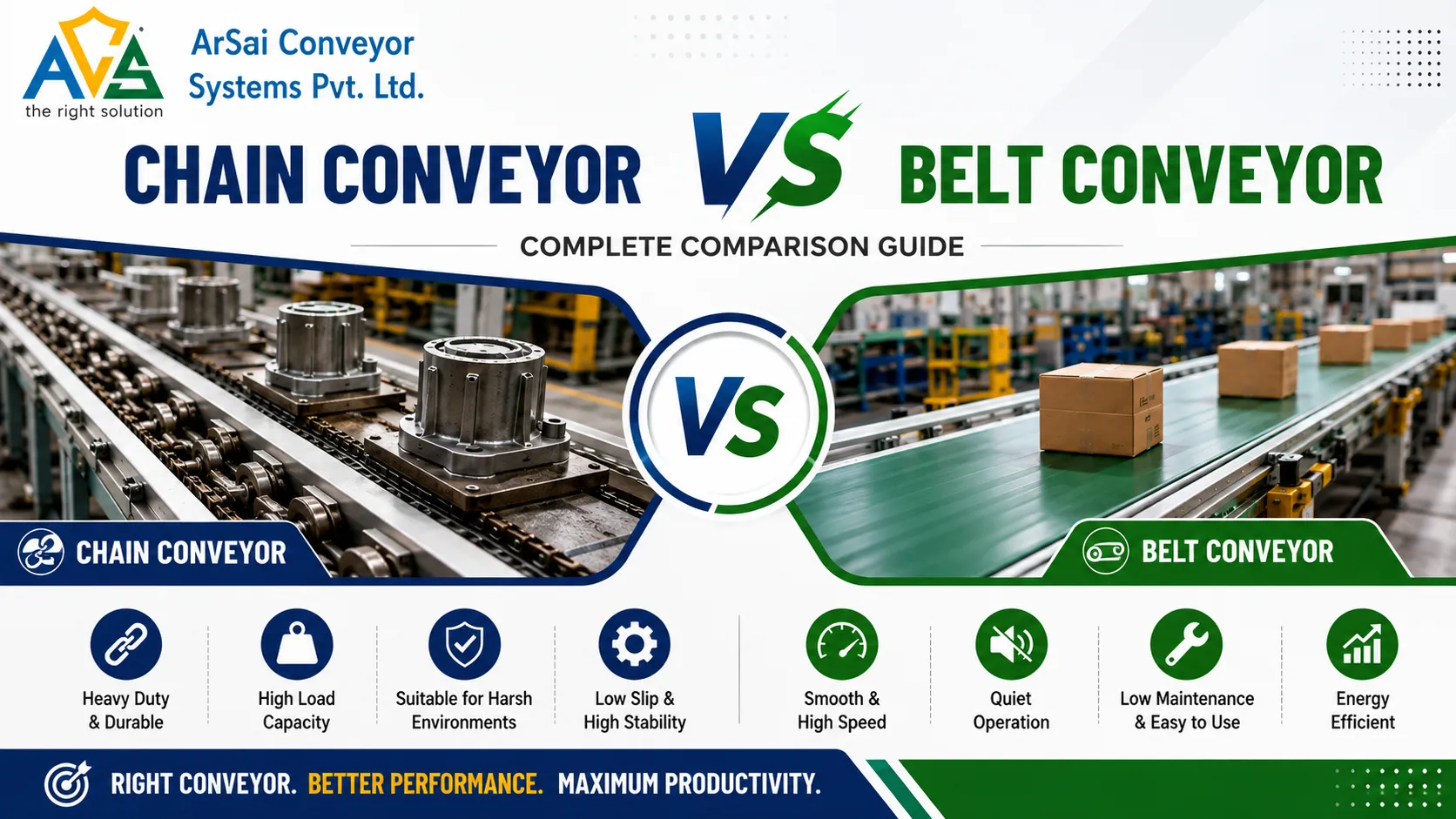
A Chain Conveyor works by driving one or multiple metal chains using a motorized sprocket. As the sprocket rotates, the chains move continuously, carrying pallets, fixtures, containers, or heavy industrial components from one workstation to another. Because the products are supported directly by the chains or attached fixtures, the system provides excellent stability even for heavy loads.
On the other hand, a Belt Conveyor operates using a continuous rubber, PVC, PU, or fabric belt driven by powered pulleys. The rotating pulleys move the belt, allowing products placed on its surface to travel smoothly through the production line. Since the belt provides continuous support across the entire conveying surface, it is ideal for transporting fragile, lightweight, or irregular-shaped products.
The choice between these working principles depends largely on the type of material being handled, operating conditions, and production requirements.
Key Differences Between Chain Conveyor and Belt Conveyor
Although both conveyor systems improve productivity, they are designed for different industrial applications.
| Feature | Chain Conveyor | Belt Conveyor |
|---|---|---|
| Driving Element | Metal Chain | Rubber, PVC or PU Belt |
| Load Capacity | Heavy Loads | Light to Medium Loads |
| Durability | Extremely High | Moderate to High |
| Speed | Moderate | High |
| Maintenance | Moderate | Low |
| Noise Level | Higher | Lower |
| Product Stability | Excellent | Good |
| Best For | Heavy Components | Packaged Products |
This comparison clearly shows that no conveyor is universally better. The ideal choice depends entirely on the application.
Advantages of Chain Conveyors
Chain conveyors are designed for demanding industrial environments where strength and durability are the primary requirements.
Some major advantages include:
- Handles extremely heavy loads with ease.
- Suitable for high-temperature environments.
- Excellent durability and long service life.
- Minimal product slippage during transportation.
- Performs well in dusty, oily, and rugged industrial conditions.
- Ideal for pallet handling and assembly lines.
- Requires fewer replacements compared to conventional belts.
Because of these benefits, chain conveyors are commonly used in industries where reliability and load capacity are more important than conveying speed.
Advantages of Belt Conveyors
Belt conveyors have become the preferred choice for industries requiring smooth, continuous, and energy-efficient material movement.
Some of their key advantages are:
- Smooth and quiet operation.
- Suitable for fragile products.
- Lower maintenance requirements.
- Energy-efficient operation.
- Can transport products over long distances.
- Simple installation and easy operation.
- Available in various belt materials for different industries.
These advantages make belt conveyors ideal for industries handling packaged goods, cartons, food products, pharmaceuticals, and lightweight materials.
Applications of Chain Conveyors
Chain conveyors are widely used in heavy-duty industrial operations where conventional belt systems may not provide sufficient strength.
They are commonly installed in:
- Automotive manufacturing plants
- Heavy engineering industries
- Steel and metal fabrication units
- Pallet conveying systems
- Paint shop conveyor lines
- Assembly plants
- Foundries
- Cement manufacturing
- Warehouses handling heavy pallets
Their rugged construction ensures reliable performance even under continuous heavy-duty operation.
Applications of Belt Conveyors
Because of their flexibility and gentle handling, belt conveyors are suitable for a wide variety of industries.
Common applications include:
- Food processing plants
- Packaging industries
- Pharmaceutical manufacturing
- Warehouses
- Airport baggage handling
- E-commerce fulfillment centers
- Textile industries
- Agriculture
- FMCG manufacturing
- Logistics and distribution centers
Their versatility makes them one of the most widely used conveyor systems worldwide.
Which Conveyor Should You Choose?
Choosing between a chain conveyor and a belt conveyor depends on several important factors, including product weight, production speed, operating environment, maintenance requirements, and available budget.
If your facility handles heavy components, metal parts, pallets, or products exposed to heat and harsh environments, a Chain Conveyor is undoubtedly the better option. Its strong construction and superior load-handling capability ensure reliable performance even in demanding industrial applications.
However, if your production line involves lightweight products, cartons, packaged goods, food items, or delicate materials that require smooth transportation, a Belt Conveyor offers better efficiency, quieter operation, and lower maintenance costs.
Before making an investment, businesses should carefully evaluate their current production process as well as future expansion plans to ensure they choose the most suitable conveyor solution.
Why Choose ArSai Conveyor Systems Pvt. Ltd.?
At ArSai Conveyor Systems Pvt. Ltd., we understand that every manufacturing facility has unique material handling requirements. With years of experience in designing and manufacturing industrial conveyor systems, we provide customized solutions that improve productivity, reduce operational costs, and maximize workflow efficiency.
Our range includes Chain Conveyors, Belt Conveyors, Roller Conveyors, Overhead Conveyors, Enclosed Track Conveyors, Power & Free Conveyors, I-Beam Conveyors, and several other advanced material handling systems tailored to different industries.
Every conveyor system we manufacture is engineered using premium-quality materials, precision components, and modern manufacturing techniques to ensure superior performance, durability, and minimal maintenance. From concept and design to installation and after-sales support, our experienced team works closely with customers to deliver reliable conveyor solutions that meet their production goals.
Conclusion
When comparing Chain Conveyor vs Belt Conveyor, it’s important to remember that both systems serve different purposes. Chain conveyors are designed for heavy-duty industrial applications where strength, durability, and load capacity are essential. Belt conveyors, on the other hand, provide smooth, efficient, and economical transportation for lightweight to medium-weight products across various industries.
The right conveyor system can significantly improve production efficiency, reduce manual handling, minimize downtime, and support long-term business growth. By partnering with an experienced manufacturer like ArSai Conveyor Systems Pvt. Ltd., businesses can invest in customized conveyor solutions that deliver reliable performance for years to come.
Frequently Asked Questions (FAQs)
1. Which is better: Chain Conveyor or Belt Conveyor?
It depends on your application. Chain conveyors are ideal for heavy-duty materials, while belt conveyors are better suited for lightweight and packaged products.
2. Where are chain conveyors commonly used?
They are widely used in automotive plants, steel industries, pallet handling systems, assembly lines, and heavy engineering facilities.
3. Are belt conveyors suitable for food industries?
Yes. Belt conveyors with food-grade belts are extensively used in food processing, packaging, and pharmaceutical industries.
4. Which conveyor requires less maintenance?
Belt conveyors generally require less maintenance, whereas chain conveyors need periodic lubrication and chain inspection.
5. Why choose ArSai Conveyor Systems Pvt. Ltd.?
ArSai Conveyor Systems Pvt. Ltd. offers customized, high-quality conveyor systems engineered for reliability, efficiency, durability, and long-term industrial performance.


Pingback: What Is a Modular Conveyor? Types, Benefits & Applications